Sling Bug Out Bag: Fast-Access Emergency Kit for Small Spaces (With 10 Photo Ideas)
A sling bug out bag is a compact emergency kit built around a crossbody sling bag instead of a full-sized backpack. It trades maximum capacity for speed, mobility, and quick access during crowded city evacuations. If you live in a small apartment, a studio, or a shared space where a 50-liter pack just isn't practical, this guide breaks down exactly how to choose, pack, and stage one for real emergencies.
This is a visual, listicle-style guide from Small Space Emergency with 10 high-quality, HDR, photorealistic photo concepts to make your planning easier and more inspiring.
1. What Is a Sling Bug Out Bag? (Answer the Main Question Fast)
A sling bug out bag combines two concepts: the bug out bag (a pre-packed emergency kit designed for rapid evacuation, typically covering 24–72 hours of independence) and the sling bag (a single-strap pack worn diagonally across the torso).
Before going further, let's define the key terms:
- Bug out bag (BOB): A pre-packed kit with essentials for surviving away from home for a set period, usually 24–72 hours. A bugout bag prioritizes mobility over comfort.
- Sling bag: A one shoulder strap pack worn crossbody, typically 4–15 liters, designed to swing from back to chest without removal.
- Crossbody bag: A general term for bags worn diagonally; often interchangeable with "sling" but tends to describe flatter, lower-hanging styles.
- Fanny pack / hip pack: A belt-mounted pouch worn at the waist or hip, typically 1–4 liters; sometimes called a chest pack when worn higher.
A sling bug out bag intentionally limits capacity in exchange for something more valuable in dense urban environments: the ability to grab it in seconds, move through tight stairwells, and access your gear without stopping. A sling bag is better suited for quick access during emergencies than nearly any other carry style.
At Small Space Emergency, our focus is emergency preparedness for small homes, studios, and city apartments. This article is built for that audience.

2. Why a Sling Bag Can Make a Great Bug Out Bag for Small-Space Dwellers
If you live in a 400-square-foot studio, you already know the pain of finding space for everything. A traditional backpack bug out bag takes up a full shelf or closet corner. A sling bag hangs flat on a wall hook, drapes over a coat rack, or tucks behind a door.
Here's why a sling works for tight quarters:
- Low bulk: Most sling bags compress to a few inches thick, fitting in spaces a backpack never could.
- Lightweight: The bag itself typically weighs under a pound, keeping your total carry style manageable.
- Always visible: Hanging by the door means you see it every day, which means you actually grab it when it matters.
- "Greyman" advantage: A neutral crossbody sling looks like a normal shoulder bag or day trip accessory, not tactical bug gear. You blend into a crowd rather than advertising your preparedness.
Many people already carry a sling as an everyday carry bag for their cell phone, wallet, and earbuds. Converting that into a minimal bug out bag is often a matter of adding, not starting from scratch.
Concrete situations where this matters:
- Fire evacuation from a 6th-floor walk-up: no elevator, stairwell is packed. A sling lets you keep both hands free on the railing.
- Chemical spill shuts down a subway line: you need a mask, a flashlight, your phone charger, and your ID. All easily accessible from a crossbody bag.
- Sudden neighborhood flooding: roads impassable, you're on foot to higher ground. A sling is far easier to manage in crowds and on public transit than a bulky pack.
3. When a Sling Bug Out Bag Works - and When It Doesn't
A sling bug out bag is not the best bug solution for every scenario. Set your expectations clearly so you can design around the limits.
When it works well:
- 24–48 hour urban displacement (heading to a friend's couch or a city shelter)
- Short evacuations: fire, gas leak, power outage, transit shutdown
- Spontaneous day trips cut short by weather or infrastructure failure
- Getting home from work during an unexpected emergency
When it doesn't:
- Multi-day wilderness survival (a sling bug-out bag has limited capacity compared to a full-sized backpack)
- Winter evacuations requiring sleeping gear, heavy insulation, and bulk food
- Families with children, pets, or members with significant medical needs
- Rural retreats where distances are long and terrain is rough
The tier system: Treat your sling as a "tier 1" fast-access pack. If space allows, keep a larger bug out backpack as "tier 2" stored nearby-under the bed, in a closet, or even in a shared storage locker. The sling gets you out the door in seconds. The backpack comes along if you have 5–10 minutes and a plan.
4. Sling Bug Out Bag vs Fanny Pack (Hip Pack) vs Backpack
Three formats dominate the emergency kit world. Here's how they compare:
Fanny pack / hip pack (2–4 liters):
- Fastest access: sits at your waist, opens in one motion
- Lowest profile: hides under a jacket easily
- Extremely limited volume: barely fits water, snacks, and a few tools
- Best as a complement to a sling, not a replacement for adults carrying gear seriously
Sling bag (4–9 liters, sweet spot for bug out):
- Balanced capacity: fits a small water bottle, power bank, first aid kit, snacks, mask, compact rain shell
- Strong mobility: navigates stairwells, buses, crowded sidewalks
- Crossbody style keeps the bag secure and accessible
- A sling bag encourages a lighter load to prevent overpacking
Backpack bug out bag (20–35+ liters):
- Maximum capacity: full clothing layers, sleeping kit, larger water supply, bulkier tools
- Two straps distribute weight evenly for long walks
- Slower to access while wearing; compact backpacks can be advantageous in navigating crowded or confined spaces, but larger ones become cumbersome
- The Vertx Gamut is a top-rated bug out bag in this category; the 5.11 Rush 72 2.0 is a well-rounded bug out backpack for multi-day scenarios; the Vertx Long Walks Pack is a compact 15L option that bridges the gap between sling and full pack
When to combine: If you have a vehicle, pair a backpack for the road with a sling or fanny pack for immediate essential items. On foot in a dense city, a single crossbody bag is ideal.
5. Key Advantages of a Sling Bug Out Bag
For renters, students, and small-space urban professionals, a sling bug out bag offers specific tactical advantages:
- Easy access: Sling bags allow quick rotation from back to front for easy access to gear. You can reach your first aid kit or mask while walking, without stopping or setting anything down. The ability to access gear without removing a sling bag offers a tactical advantage in emergencies.
- Improved mobility: Navigating stairwells, boarding a bus, squeezing through a crowded lobby-a sling doesn't knock into people, doorframes, or seats the way a big pack does.
- Security: Worn in front in a crowd, the crossbody sling discourages snatch theft. Your essentials stay in your line of sight.
- Comfortable carry for short durations: For 1–6 hours of walking with a modest load (under 5–6 pounds), a sling with a padded strap delivers a comfortable fit without overheating your back.
- Transit-friendly: Sling bags facilitate easier access while seated in vehicles compared to traditional backpacks. You don't need to wrestle it off in a cramped subway seat.
6. Key Drawbacks and Tradeoffs You Need to Plan Around
Honesty about limitations lets you design around them instead of being surprised.
- Limited food and water: A sling carries roughly one small water bottle (500–750 ml) plus a few bars and snacks. FEMA recommends one gallon of water per person per day for emergency preparedness-a sling won't get you there. Plan for refilling or supplementing.
- Weight imbalance: Carrying weight on one shoulder can cause muscle fatigue during long periods of use. Keep total packed weight under roughly 10–12 pounds (4.5–5.5 kg) for walks of several hours.
- Weather protection gaps: Many lifestyle sling bags, including popular camera gear carriers like Peak Design options, are water-resistant but not fully waterproof. A waterproof bag is essential for wet environments if you expect sustained rain. Consider a rain cover or waterproof inner pouches.
- Not a standalone system: Think of the sling as part of a layered system-paired with jacket pockets, a waist pouch, or a small rolling suitcase if feasible. Select a waterproof bag if facing wet environments as your backup layer.
7. Volume, Size & Fit: How Big Should a Sling Bug Out Bag Be?
The sweet spot for a sling-based bug out bag is 4–9 liters. Here's the breakdown:
- 3L micro sling: Ultra-minimal. Fits phone, wallet, keys, a mask, and a small flashlight. Think of this as an everyday carry bag with emergency extras.
- 6L balanced hybrid: Enough room for a water bottle, power bank, compact first aid kit, a few snacks, and a rain shell. This is the goldilocks zone for most solo urban dwellers.
- 9–13L expanded sling: Pushes into mini-backpack territory. Room for a light change of clothes, more food, and a larger aid kit. Starts to feel bulky on one shoulder.
Note that some manufacturers list a sling bag as typically having a capacity of 15L to 30L. At those sizes, you're functionally carrying a small backpack with a single strap-which sacrifices the core advantage of a true sling. For bug out purposes, stay at the lower end unless your body frame and fitness allow the extra load.
Fit guidance: Measure from your shoulder to the opposite hip. The strap should adjust so the bag rides at your lower rib or hip level, close to your torso without swinging. Taller "mini-backpack" slings suit smaller frames well; wider, shallower designs mimic a big fanny pack and work better for quick access to flat items like an e reader or folded maps.
A bug out bag should be spacious and easily organized. Choose a bag that balances enough room with the discipline to stay compact. Bug out bags should have multiple storage compartments to keep things sorted even under stress.
8. Choosing Sling Bag Styles for a Bug Out Role
Not all sling bags are built for emergencies. Here's how the major style families perform:
Fanny pack look-alike slings: Wide, low-profile designs that sit close to the body. Great for blending in-they tuck under a jacket and draw zero attention. Limited depth, but solid for ultra-essential kits.
Outdoorsy / athletic slings: Technical fabrics, mesh back panels, water bottle holder options, compression straps. More conspicuous in city environments but better padded for longer wear. Good if your evacuation route includes parks or trails.
Tactical sling bags: MOLLE webbing, Velcro fields, robust hardware. The Viktos Perimeter 25 is a versatile tactical EDC bag in this category; the Vertx Overlander is ideal for tactical survival needs. However, tactical aesthetics draw attention. In an urban evacuation, looking like you're geared up can create problems rather than solve them.
Minimalist fashion / commuter crossbody bags: Simple design in neutral colors-gray, black, navy, olive. These hide emergency contents in plain sight. A great sling for bug out use doesn't have to look like it belongs on a firing range. It just needs good organizational features inside a clean exterior shell.
9. Fabric, Zippers & Hardware: Durability for Real Emergencies
In a real bug out, you do not want your strap, zipper, or buckle to fail on a dark staircase or in heavy rain.
Fabric and denier: "Denier" measures yarn weight and density-not strength directly, but it correlates. For most sling bags, 400–600D nylon or polyester offers a strong balance of durability and weight. Cordura Classic fabrics range from 330D to 1000D high-tenacity nylon 6,6; 1000D Cordura is heavy-duty, resisting abrasion for 80,000+ cycles in lab tests-outperforming even 1680D ballistic nylon in abrasion resistance. Durable bags withstand stress from extended use and elements. Durability is a key feature for effective bug out bags. A bug out bag should be durable and affordable-you don't need to spend tactical-grade prices when 500D Cordura handles most real-world abuse.
Zippers: Durable zippers ensure equipment safety and accessibility. Look for YKK AquaGuard-style water-resistant zippers with coated tape and reverse coils. They handle rain and splashes well, though no zipper is truly waterproof without fully sealed seams. Choose a waterproof bag if expecting wet conditions alongside a quality zipper setup. Waterproof bags provide long-term protection in wet environments.
Hardware: Plastic buckles from reputable brands (Duraflex, Woojin, ITW) often beat cheap metal for comfort and weight. They won't rust, they flex without snapping, and they shave grams. Look for bartacked stress points and double-stitched strap anchors at every load-bearing junction.
10. Comfort Features: Straps, Back Panels & Carry Options
Comfort determines whether you'll actually grab the bag when it matters. An uncomfortable sling stays in the closet.
- Strap width and padding: For 4–9L loads, a strap width of 1.5–2 inches with light foam padding prevents digging. Bags with good weight distribution enhance comfort during use. Narrow, unpadded straps become painful within minutes under any real load.
- Quick-release buckle: Valuable in emergencies-freeing yourself from the bag quickly in a crowded bus, a jammed doorway, or while climbing through debris.
- Back panel: Unpadded panels keep the bag slim for concealment under a jacket; mesh or foam padding helps on longer walks and in hot climates. Comfortable bags allow for easy maneuverability in emergencies. Bug out bags should be comfortable for extended wear, even if that means adding a thin foam panel.
- Reversible or ambidextrous straps: Being able to swap shoulders during a multi-hour walk prevents strain on one side. Fixed-shoulder designs work, but adjustable shoulder straps with reversible anchor points are worth seeking out.
- Stabilizer strap: A simple under-arm or waist tie reduces bounce when jogging, biking, or descending stairs quickly.
11. Organization: Packing for Fast, Stressful Exits
In a fire drill or real evacuation, you will not think clearly. Your bag must be pre-organized for muscle-memory access. Pack items in order of need for quick access-things you'll reach for first go in the most easily accessible spots.
Recommended layout:
- Front pocket (fast access): Wallet, phone, ID, keys, mask. These are the items you need in the first 30 seconds.
- Main compartment: Bulkier items-water bottle, food, rain shell, spare clothing.
- Internal mesh pockets / admin panel: First aid pouch, hygiene kit, cables, power bank.
- Rear security pocket (against your back): Emergency cash, copies of documents, small USB drive.
Use clear bags for organizing smaller items in your pack-it speeds identification under stress. Color-coded pouches also work well: red for medical, blue for hygiene, gray for tools. These pouches can transfer easily between your sling and a larger bug out bag if you need to scale up.
Ensure your bag has ample storage compartments for organization. Keep at least one small pocket uncluttered specifically for last-second additions-prescription meds, spare charger, spare keys. These are the items most often forgotten in a rush.
Organizing a compact grab-and-go kit into core survival categories is advisable: documents, water, food, medical, navigation, power, safety, and clothing.
12. Core Sling Bug Out Bag Packing List (Urban Apartment Version)
This list targets city dwellers in a small home, aiming at roughly 24–48 hours of flexibility away from home. Include a first aid kit in your bug out bag-it's non-negotiable.
Documents & money:
- Copies of ID, driver's license, or passport (a waterproof document pouch can protect important documents during emergencies)
- Emergency cash in small bills ($50–$100)
- Insurance card copies, emergency contacts list
- Digital backups on a small USB drive or cloud
Water & food:
- 500–750 ml steel water bottle (collapsible water bottles save space when empty and can be filled on the move)
- Electrolyte packets (2–3)
- 3–6 dense energy bars or trail mix pouches
- Water purification tablets serve as a reliable backup for physical water filters
- A personal water filter allows safe sourcing of water from streams or taps in extended scenarios
Medical & hygiene:
- Compact first aid kit (compact first aid kits should focus on trauma and immediate care: bandages, antiseptic wipes, blister patches, small scissors, nitrile gloves)
- Personal medications (48-hour supply)
- N95 or KN95 masks (2–3)
- Hand sanitizer, wet wipes
- Emergency Mylar blankets effectively reflect body heat and take up minimal space-pack one
Navigation & communication:
- Compact LED flashlight or headlamp (compact lighting options like LED flashlights or headlamps are crucial for emergencies)
- Whistle
- Physical maps are essential in case GPS or cell towers fail during emergencies-carry a printed city map
- USB-C power bank, minimum 10,000 mAh
- Charging cable
Safety & self-protection:
- Whistle (doubles as signaling)
- Sturdy gloves
- Small knife or multitool (check local laws)
Clothing basics:
- Lightweight packable jacket or rain poncho
- Spare socks (wool or synthetic)
- Compact beanie or cap
Multi-use items save precious space and weight in emergency kits. Your everyday carry umbrella doubles as weather protection. Your commute power bank doubles as your blackout power source. Your flu-season mask doubles as your shelter mask.
Adapt based on climate, building type, and family situation. If you have kids, add children's snacks, meds, and comfort items. If you have pets, add a collapsible bowl and a small bag of food.
13. Tiered Carry: Fanny Pack + Sling Bag + Full Bug Out Bag
Think in layers: EDC on your body, sling bag as grab-and-go, larger backpack or tote for extended evacuations.
- Fanny pack / hip pack (tier 0): Holds absolute essentials-ID, a little cash, mini flashlight, a few bandages. Even if you drop or stash the sling, these items stay with you. Think of it as your personal item insurance policy.
- Sling bag (tier 1): Your 4–9L core kit, packed and staged by the door. This is the grab-and-go.
- Full backpack (tier 2): A 20–35L pack stored under the bed or in a closet. Contains extended clothing, sleeping gear, more food and water. Deploy it if you have 5+ minutes and a clear route.
A sling bug out bag can nest inside a larger bug out backpack in the closet. When you need to leave, pull the sling out and wear it on its own. If you have time to take both, wear the backpack on your back and the sling across your chest, shifting weight and access smartly.
For very small studios where even a backpack won't fit stored, start with a fanny pack + sling combo. That's a handy two-layer system that takes up almost no space.
14. Everyday Carry to Bug Out: Turning Your EDC Sling into an Emergency Kit
Many of you already carry sling bags daily. Leverage that instead of buying a totally separate bug out bag.
The process:
- 1Audit your current everyday use contents: List what's already in your sling-phone, earbuds, wallet, sunglasses, snacks.
- 2Add or swap bug out essentials: Compact first aid pouch, emergency cash envelope, extra meds, a mask, and a small flashlight. These are small enough to live permanently in the bag.
- 3Reserve 20–30% of capacity: Dedicate this space to emergency gear that never leaves the bag-even when you're tempted to fill it with lunch containers.
- 4Create a mini checklist card: A laminated card inside a sleeve listing all items. Review monthly.
Real-life crossovers make this easy: the same power bank you charge your phone with on your commute powers your flashlight during a blackout. The same hand sanitizer you use in flu season works at a shelter. Multi-use items save precious space and weight in emergency kits.
15. Tactical vs Low-Profile Sling Bug Out Bags
Tactical sling bags are popular. But they're not always the right pack for dense urban settings.
Pros of tactical-style slings:
- Rugged build with durable materials
- MOLLE webbing and attachment points for modular gear
- High internal organization
- Sometimes include quick-draw or concealed compartments
Cons:
- They attract attention-on a commuter train, a MOLLE-covered bag with Velcro patches screams "prepared target"
- Can look out of place in office buildings, shelters, or public spaces
- Sometimes heavier due to hardware and reinforcement
Choose a bug out bag with a discreet appearance. Opt for a neutral color bag to avoid drawing attention-gray, navy, black, or muted earth tones. Small Space Emergency generally recommends civilian-looking exteriors for urban use.
The compromise: Tactically capable internals (good organization, durable zips, bartacked stress points) in a simple exterior shell without loud branding. A great bag doesn't need to look military. It just needs to work.
16. Realistic Urban Scenarios Where a Sling Bug Out Bag Shines
Let's make this concrete with time and place.
Scenario 1: Apartment fire on a weeknight. Your building's alarm goes off at 2 AM. Stairwells are clogged with neighbors. You grab your sling from the wall hook, throw it crossbody, and descend six flights with both hands on the rail. A big backpack would bang into the wall, slow you down, and make passing other residents difficult. Your sling holds your ID, phone, power bank, and a few essentials-enough room for a night at a friend's place or shelter.
Scenario 2: Sudden transit shutdown during a storm. Subway service halts mid-commute. Streets are flooding. Your sling provides a compact rain shell, a flashlight for dark tunnels, your power bank for calling a ride, and a mask if air quality drops. Quick and easy access to each item while standing on a packed platform.
Scenario 3: Earthquake or gas leak in a dense neighborhood. You need ID, meds, and minimal supplies for overnight displacement. A sling with your personal item essentials gets you to a friend's apartment or a shelter without slowing you down over debris and through narrow doorways.
The smaller profile of a sling bag also matters in shelters or crowded lobbies where large backpacks are cumbersome. You're not fighting for floor space with a 40-liter pack.
17. Seasonal & Climate Adjustments for Your Sling Bug Out Bag
A one-size-fits-all sling setup rarely works across seasons.
Cold climates:
- Add a compact beanie, lightweight gloves, and a neck gaiter
- Pack an emergency Mylar blanket (weighs almost nothing, reflects body heat)
- Stash bulkier layers in your coat pockets rather than the sling
- Consider chemical hand warmers (two-pack weighs under 2 oz)
Hot / humid climates:
- Prioritize electrolyte packets and extra water access
- Add sun protection: compact sunscreen, sunglasses, brimmed cap
- Choose a sling with breathable mesh back panel materials
- Extra masks if air quality events are common in your region
Rainy cities:
- Prioritize a compact rain shell or ultralight poncho-it should strap under a compression strap or bungee on the sling
- Ensure your bag has coated zippers or a rain cover
- Use waterproof inner pouches for electronics and documents
Create a small "seasonal swap" box at home-a shoebox or zippered pouch with summer and winter items. Rotate contents into your sling every spring and fall.
18. Staging & Storage in Small Spaces
Where you keep your sling bug out bag in a 300–700 square foot apartment determines whether you'll actually grab it.
Best staging spots:
- Wall hook near the front door (most accessible, visible daily)
- Inside a coat closet, hanging on the rod or door hook
- On the back of an office chair or desk chair
- In a shallow entryway cabinet or shelf
- Behind the bedroom door on a simple over-door hook
Keep one sling per adult, packed and in a consistent, visible location. If your household has two adults and a teenager, stage three slings-labeled or color-coded by owner, but exteriors kept low-key.
Practice a 60-second grab-and-go drill: time how fast you can grab your sling, check for keys and phone, and exit to the hallway or street. Run it once a quarter. If it takes more than 90 seconds, simplify your staging.
19. Maintenance, Rotation & Regular Checks
Gear that sits for years may fail when you finally need it.
Schedule a sling bag check day at least twice a year. Tie it to daylight savings time changes-easy to remember.
Checklist:
- Rotate snacks and food: check expiration dates, replace stale items
- Refill or replace water if it's been sitting (especially in heat)
- Charge power bank fully; test USB cables
- Verify medications are current; refill prescriptions as needed
- Confirm document copies are up to date (new address, new insurance)
- Inspect zipper function: sliders should glide smoothly, no stuck teeth or debris
- Inspect straps and stitching: look for fraying at anchor points, worn buckles, loose threads
- Replace any broken hardware immediately
Log your changes on a small card inside the bag: "Last checked: [date]. Replaced: [items]." This takes 30 seconds and saves guesswork next time.
20. Safety, Legal & Ethical Considerations
Some readers will add self-defense tools or specialized gear to their sling. A few ground rules:
- Check local laws on pepper spray, pocket knives, multitools, and other defensive tools. Laws vary dramatically by city and state. What's legal at home may be illegal on public transit, in an office building, or at an airport.
- Prioritize medical basics and signaling: Bandages, a tourniquet (with training), nitrile gloves, a whistle, and a flashlight are universally useful and universally legal. Emphasize these over weapons for most small-space urban users.
- Documents: Carry copies or digital backups in your sling. Keep originals stored more securely at home (fireproof safe, lockbox). A waterproof document pouch protects what's in the bag.
- Responsible use: A sling bug out bag is for safety and resilience. It's not a confrontation kit. Avoid aggressive displays of tactical gear in public-this can escalate tension rather than defuse it.
21. 10 High-Impact Photo Ideas for a Visually Rich Sling Bug Out Bag Article
All photos should be high-resolution, HDR, photorealistic, with a clean, modern, urban-apartment aesthetic and consistent color grading. Here are 10 concepts:
Photo 1: Wall Hook Wide Shot
A neutral-colored sling bag (charcoal, slate gray, or muted olive) hanging on a simple wall hook beside an apartment front door. Shoes on a mat below, a compact umbrella leaning nearby. Natural window light from the side creates soft shadows across the bag's fabric texture. The image communicates "ready to grab."
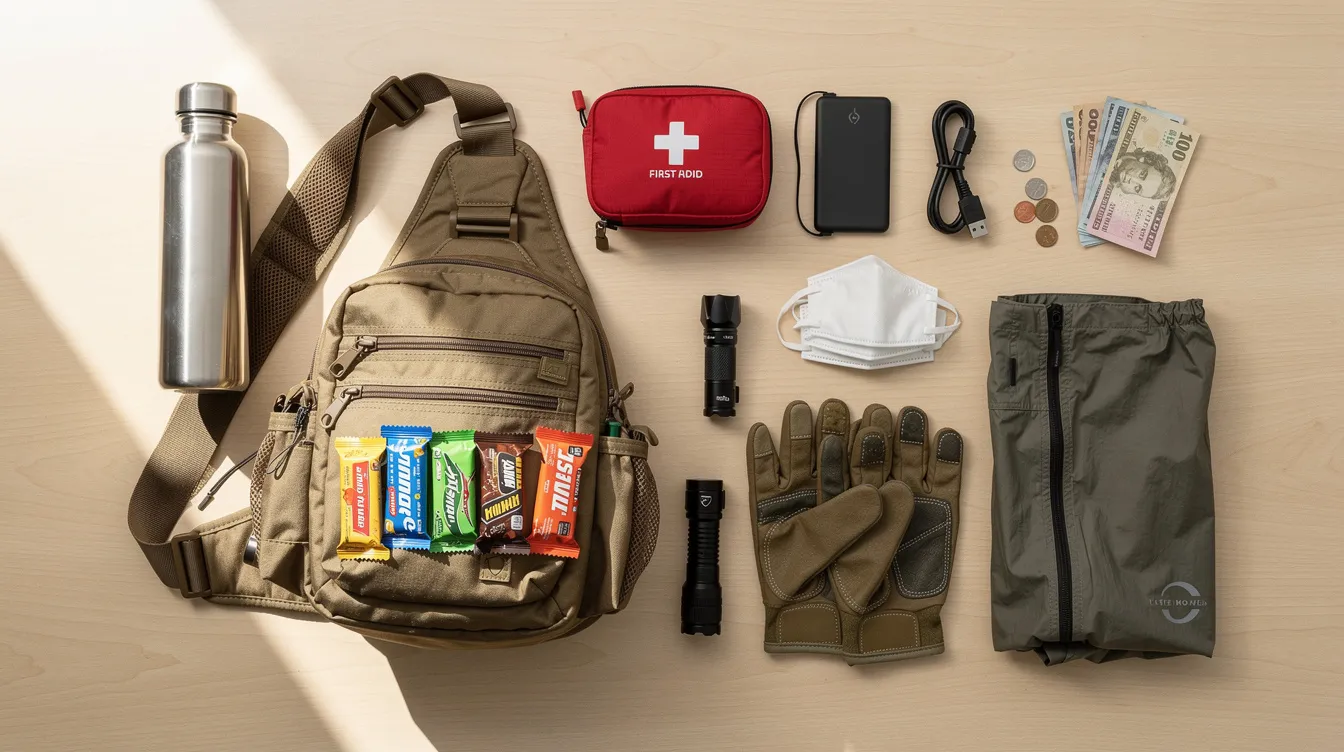
Photo 2: Overhead Flat Lay
The fully packed sling bug out bag opened on a warm-toned wooden tabletop. All the basics laid out in neat rows: a steel water bottle, compact first aid kit, power bank with cable, energy bars, N95 masks, LED flashlight, nitrile gloves, folded rain shell, emergency cash in an envelope, a whistle, and a folded city map. Everything organized by category. Shot directly from above with clean, even lighting.
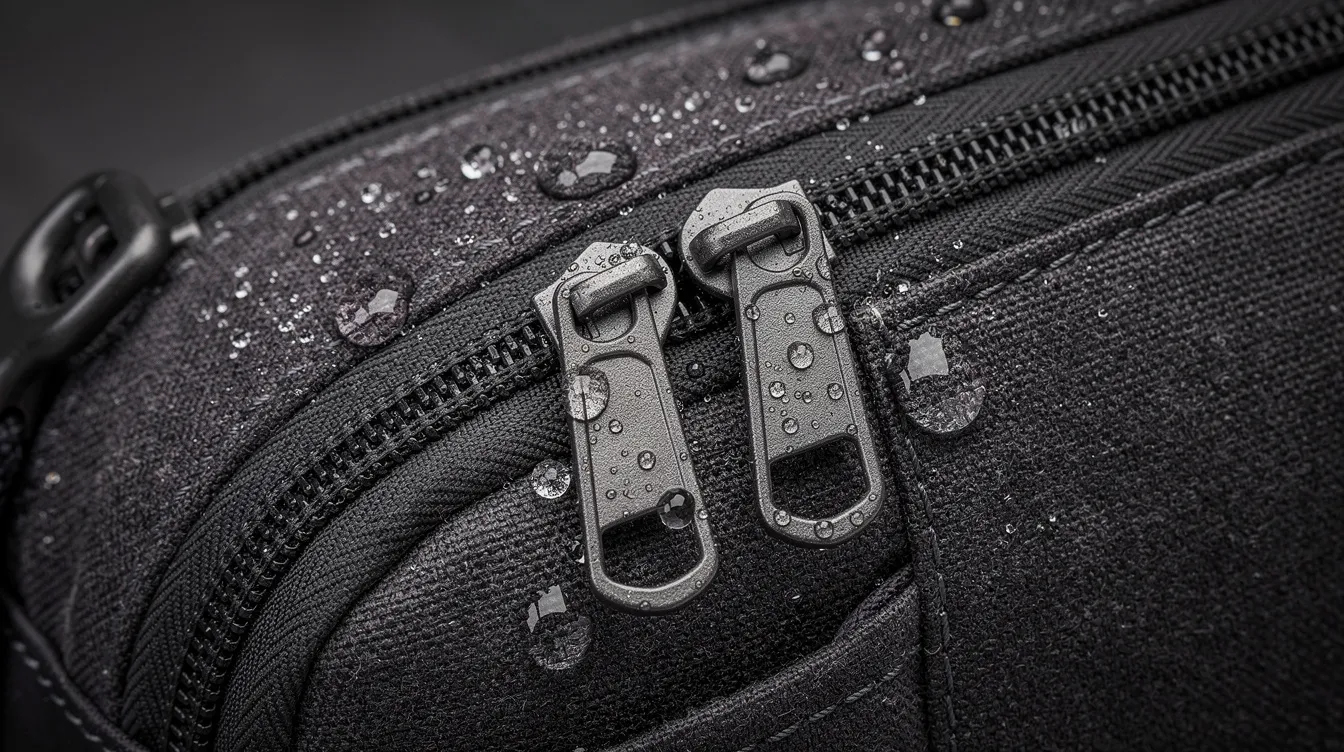
Photo 3: Close-Up HDR Macro
A tight crop on a heavy-duty zipper and buckle on the sling bag's main compartment. Raindrops bead on the nylon fabric, emphasizing water resistance. Shallow depth of field blurs the background. The focus is on material quality-thread count visible, zipper teeth sharp, hardware reflecting light. This photo sells durability.
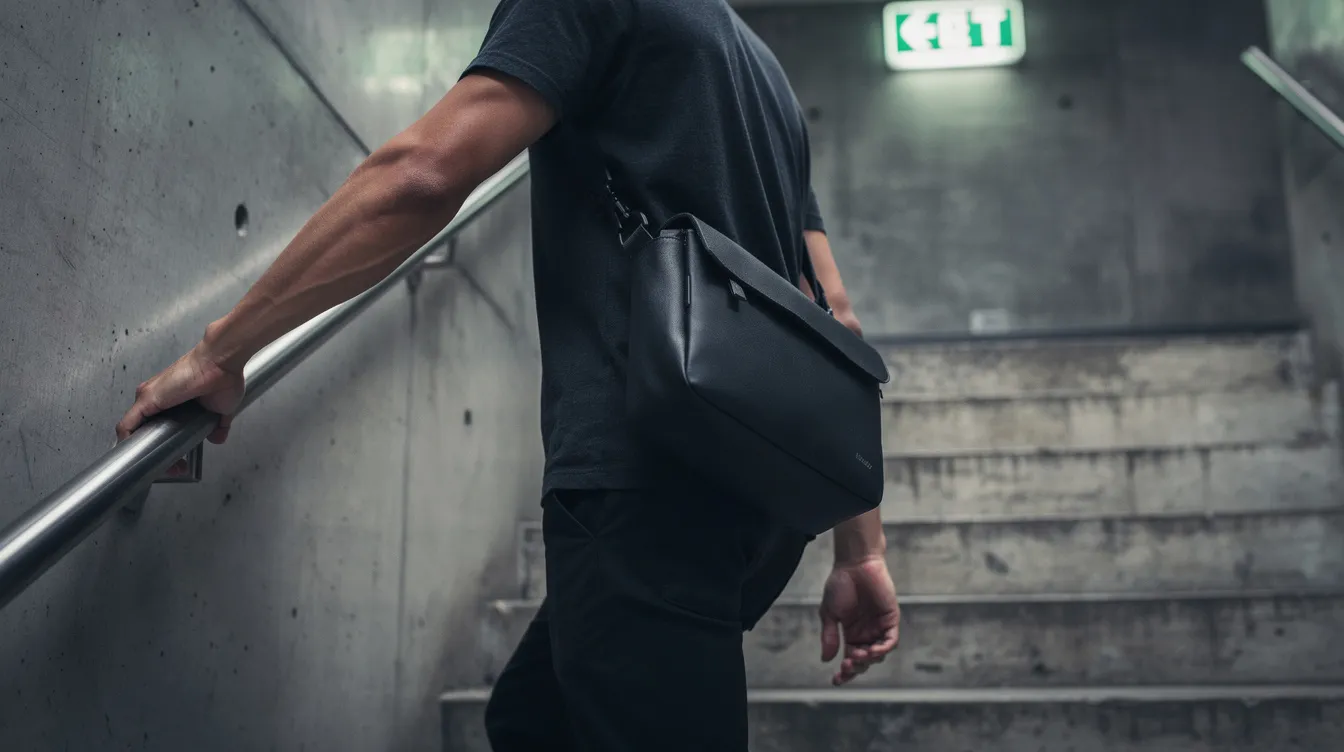
Photo 4: Stairwell Lifestyle Shot
A person wearing the sling crossbody on their chest, descending a concrete apartment stairwell. One hand grips the metal railing. A green emergency exit sign glows in the background. Shallow depth of field keeps the person and bag sharp while the stairwell recedes into soft focus. Movement and purpose.
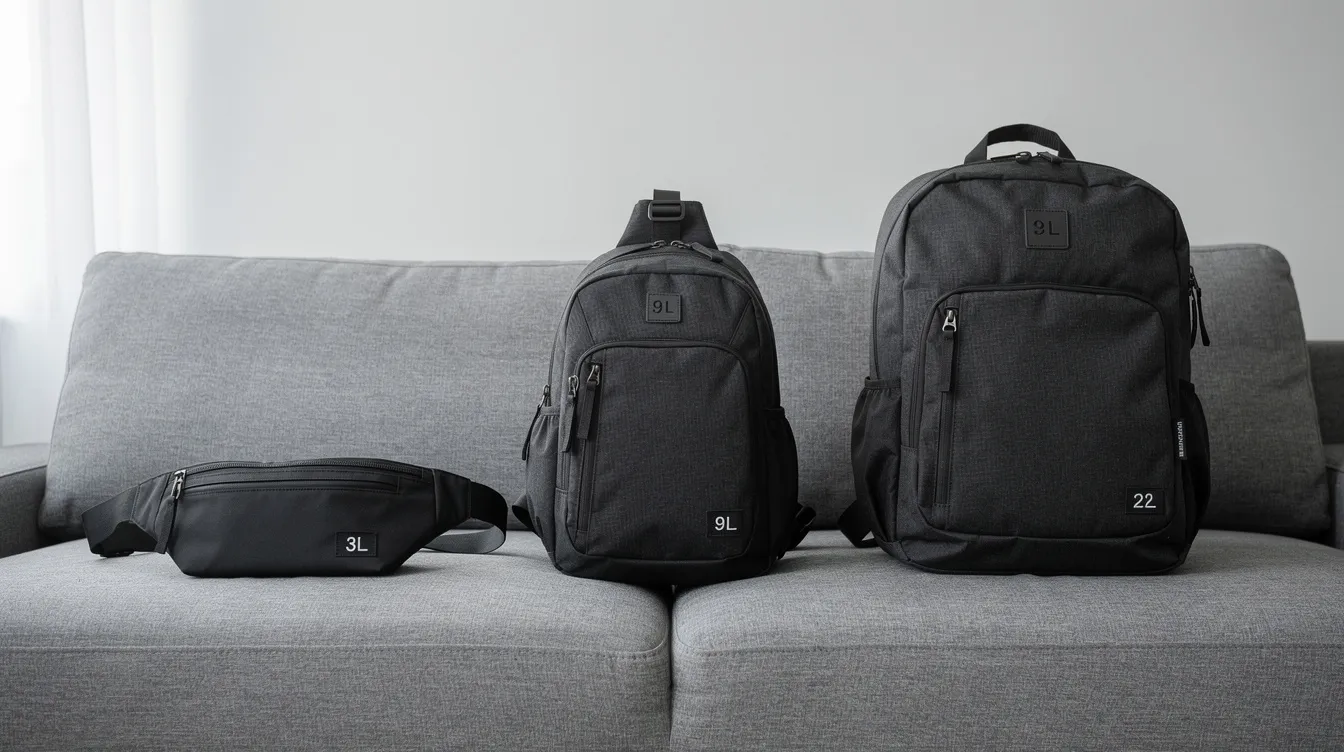
Photo 5: Three-Bag Size Comparison
A modern couch with three bags arranged left to right: a compact fanny pack (~3L), a medium sling bag (~6L), and a full backpack bug out bag (~30L). Each bag is roughly the same neutral color family. Visual size difference is immediately obvious. A small label or tag near each could indicate approximate volume. Clean, well-lit living room setting.
Photo 6: Interior Organization Shot
The sling bag unzipped and spread open on a soft surface, revealing its interior. Color-coded pouches are visible: a red pouch (medical), a blue pouch (hygiene), a gray pouch (tools). Mesh pockets hold cables and small items. A zippered pocket with a document sleeve peeks from the back panel. Soft window light creates an inviting, organized feel.
Photo 7: Nighttime Urban Street Scene
A subject walking on a city sidewalk at night, wearing the sling bug out bag in front across their chest. Streetlights and storefronts provide warm ambient light. The bag looks like any everyday crossbody bag-discreet, low-profile, unremarkable. The mood is calm confidence, not tactical aggression.
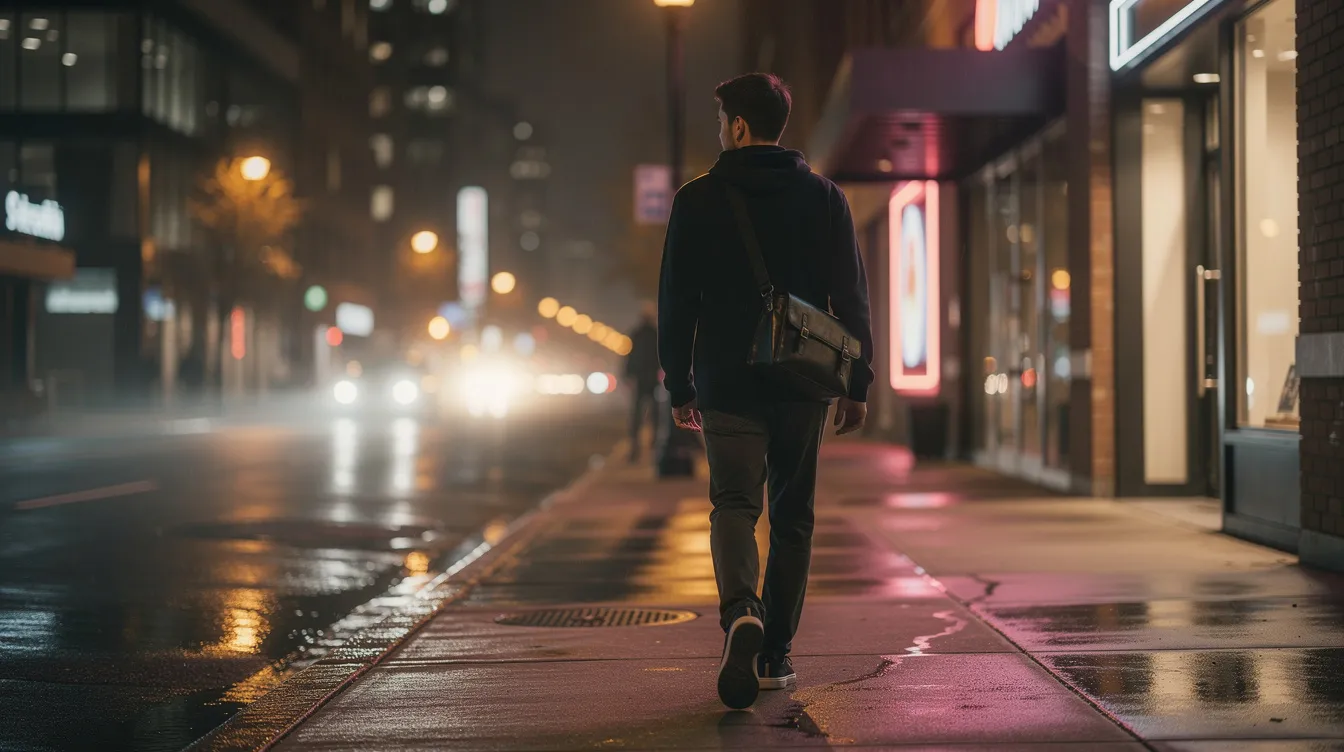
Photo 8: Seasonal Variation Split Image
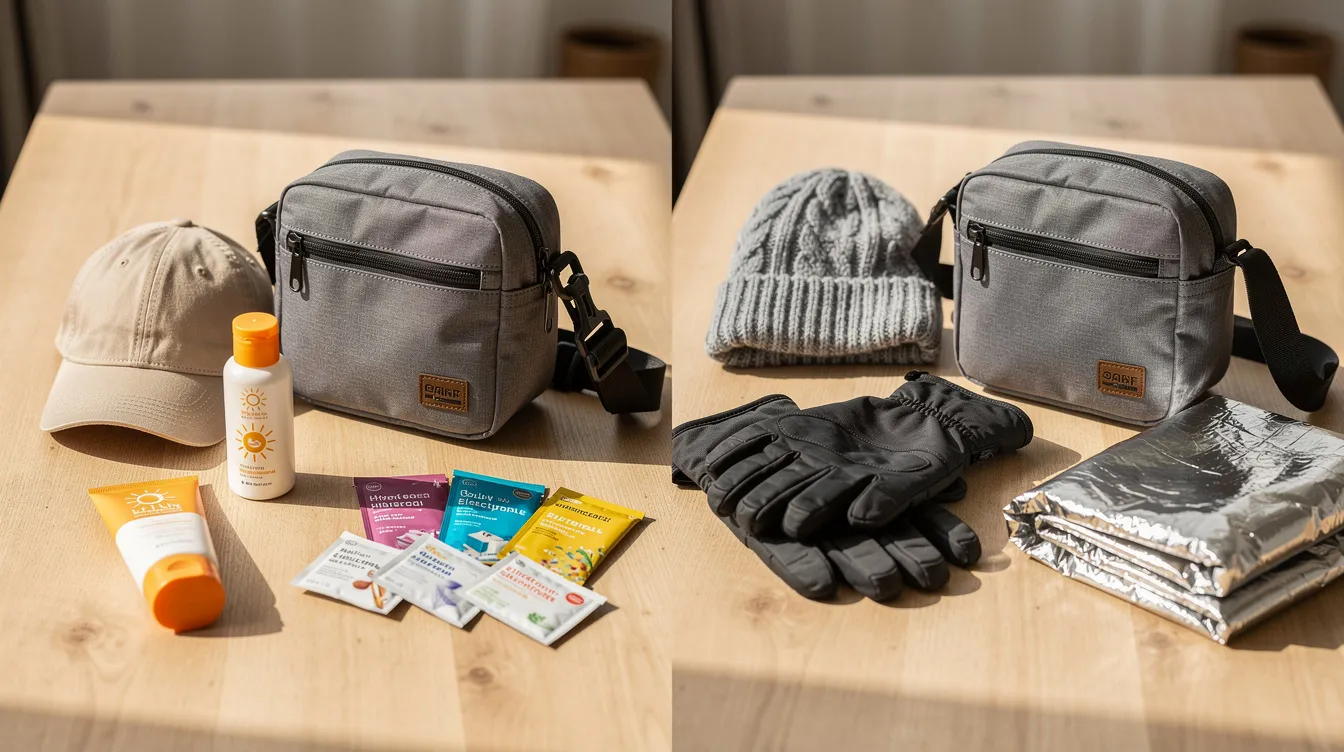
The same sling bag centered on a table. Left side shows summer items: sunscreen tube, lightweight cap, electrolyte packets, sunglasses. Right side shows winter items: knit beanie, compact gloves, hand warmers, a foil emergency blanket. Split composition with a clean dividing line. Demonstrates how the same bag adapts across seasons.
Photo 9: Workspace EDC Integration
The sling bag hanging on the back of a modern office chair or standing upright on a desk beside a laptop and a coffee mug. The setting is a small home office or studio workspace. The message: this bag lives in your daily life, not buried in a closet. Clean, bright, professional atmosphere.

Photo 10: Household Multi-Sling Lineup
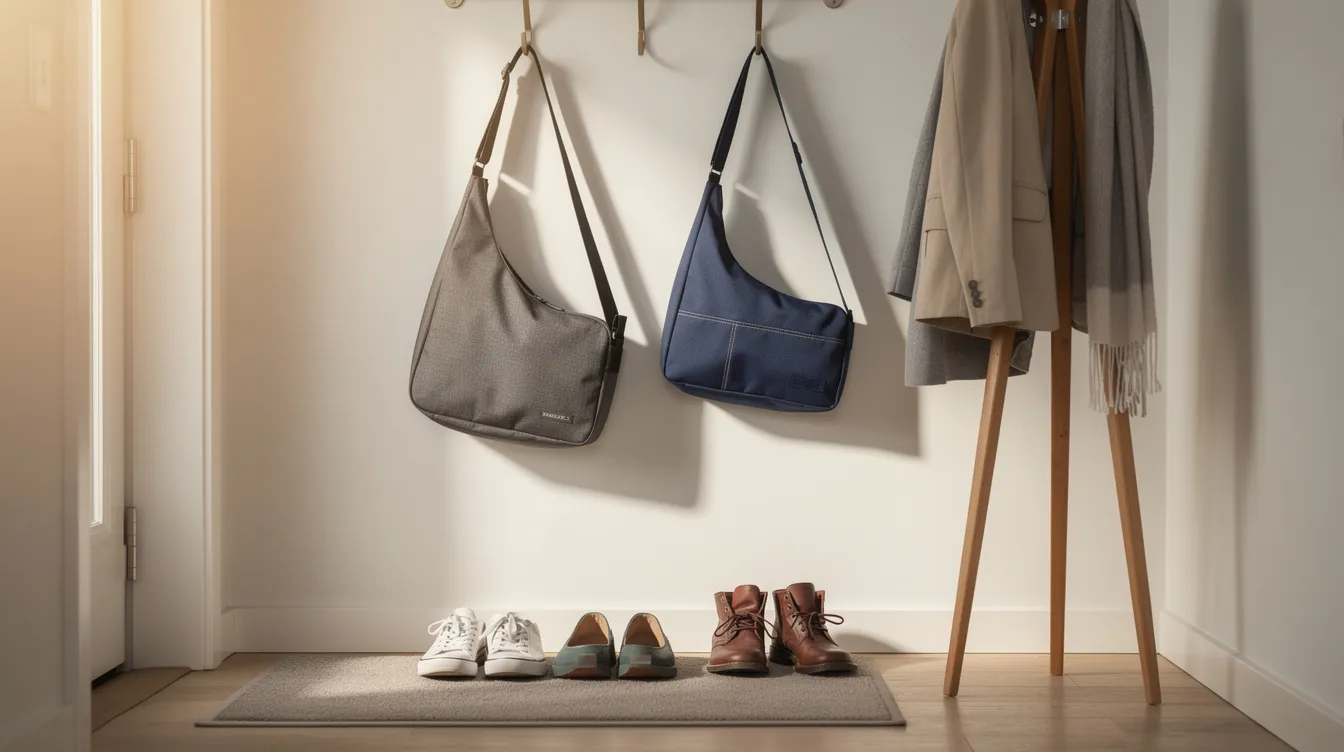
A small apartment entryway showing two or three sling bags lined up on hooks or a narrow shelf near the door. Each bag is slightly different in size or color (adult, teen). Shoes below, coats nearby. The image shows a household-level preparedness setup without clutter. Warm, lived-in atmosphere with consistent muted tones.
22. Example Sling Bug Out Bag Loadout (Step-by-Step Walkthrough)
Here's a concrete example: a 6–8 liter sling bag packed for a solo adult in a mid-size US city, autumn 2026.
Step 1: Rear security pocket (against your back)
- Folded copies of ID and insurance card in a waterproof sleeve
- $80 in small bills
- Small USB drive with digital document backups
Step 2: Main compartment (bottom, heavy items first)
- 500 ml steel water bottle, positioned upright against the back panel
- 10,000 mAh USB-C power bank with coiled cable
Step 3: Main compartment (above heavy items)
- Lightweight packable rain shell, rolled tightly
- 3 energy bars and a small bag of trail mix
- Spare wool socks, compressed flat
- Compact beanie
Step 4: Internal mesh pockets
- First aid pouch (bandages, antiseptic wipes, blister patches, small scissors, 2 nitrile gloves)
- Small hygiene kit (travel toothbrush, mini toothpaste, soap sheet, hand sanitizer)
Step 5: Front pocket (fast access)
- Phone
- Wallet with everyday cash and transit card
- Keys
- 2 N95 masks
- Small pouch with daily medications
Step 6: Strap pocket (if present)
- Compact LED flashlight
- Whistle
Final check: Zip every compartment. Confirm the bag retains a slim profile-it should still ride close to your torso without bulging. Put on a light jacket over it. The bag should be barely visible. Confirm the strap length is right: snug across your chest, not dangling at your hip.
The bag holds a surprising amount in a small footprint. This is the right pack for someone who needs to move fast, stay light, and access essential items without slowing down.
23. Common Mistakes with Sling Bug Out Bags (And How to Avoid Them)
It's normal to revise your setup several times. Here are the most common errors:
Mistake 1: Overpacking heavy tools. Full-size multitools, large flashlights, big knives-these make the sling uncomfortably heavy and bulky. A great choice is a compact multitool under 4 oz, a pocket-sized LED light, and nothing more.
Correction: Choose lightweight, dual-purpose items. If it's too heavy to carry comfortably in one hand, it's probably too heavy for a sling.
Mistake 2: Ignoring water and power. Some people fill their sling with gadgets-radios, tools, camera gear accessories-but forget a water bottle and charged power bank. Water and power are the two most critical resources in urban emergencies.
Correction: Your water bottle and power bank go in first. Everything else fits around them.
Mistake 3: Going too tactical. A full MOLLE sling covered in patches and carabiners might look impressive in a gear review, but in an urban evacuation it marks you. Blending in matters.
Correction: Choose a neutral crossbody bag with a simple design. Muted colors, minimal branding, no visible webbing. Reserve the tactical internals for organization, not display.
Mistake 4: Assuming water resistance equals waterproof. A DWR-coated sling will shrug off light rain. In a sustained downpour, your contents will get wet.
Correction: Use waterproof inner pouches for electronics, documents, and medications. Test your bag in actual rain before trusting it.
24. Putting It All Together: Your Next Steps with Small Space Emergency
A sling bug out bag is a strong choice for anyone in an apartment, condo, or small home with limited storage. It won't replace a full bug out backpack for every scenario-but for the rapid, urban, get-out-now moments that city living throws at you, nothing beats it for speed, accessibility, and low-profile readiness.
Your action plan:
- 1This week: Choose or repurpose a sling bag. Audit what you already own. If your daily crossbody can serve as a starter, use it.
- 2This month: Assemble a starter kit from items you already have-phone charger, meds, a mask, some cash, a water bottle. Fill the gaps over the next paycheck or two.
- 3Ongoing: Schedule a recurring calendar reminder for quarterly bag checks and seasonal gear swaps.
Explore more Small Space Emergency resources on compact storage ideas, emergency kits for tiny homes, and apartment-specific evacuation planning.
The best sling bug out bag is the one you actually pack, store by the door, and feel confident grabbing when seconds count.
Editorial note: this guide provides general preparedness information, not emergency, medical, legal, or engineering advice. Recommendations are cross-checked against public emergency-management guidance and adapted for small-space living. During an active emergency, follow your local authorities and emergency services. See our editorial standards and affiliate disclosure.