Military Survival Kits for Small Spaces
Military Survival Kits: What They Are and Who They're For
A military survival kit is a rugged, mission-ready emergency kit modeled on gear used by armed forces - U.S. Army, Marines, and SERE programs - built around worst-case scenarios where failure means life or death. Unlike a generic emergency kit stuffed with bargain-bin flashlights and flimsy bandages, these kits prioritize durability, redundancy, and modular organization. Military survival kits are designed for outdoor and tactical scenarios, but the same principles that keep military personnel alive in combat zones can keep civilians alive during blackouts, wildfires, and hurricanes.
This collection focuses on adapting that military-grade approach for people living in small apartments, studios, walk-ups, and tiny homes. Compact survival kits are valuable for people living in small homes with limited storage - but "compact" doesn't have to mean "compromised." Whether you face the threat of a NYC power outage trapping you above the 10th floor, a California wildfire like the 2025 Eaton and Palisades fires that forced evacuations with almost no warning, or a Gulf Coast hurricane demanding days of shelter-in-place, a properly built military-style kit gives you options that generic products simply don't.
The difference comes down to philosophy. A typical red-plastic emergency kit from a big-box store covers the basics - food, water, a first aid kit - but often with fragile components and no plan for escalation. A military-inspired survival kit layers multiple fire-starting methods, packs trauma-level medical supplies instead of just adhesive bandages, uses ripstop Cordura fabric and metal buckles instead of plastic, and organizes everything into grab-and-go modules that work in a 400-square-foot studio as well as they do in a forward operating base. Below, you'll find a visual guide to what these kits actually look like inside real small spaces, the major types worth considering, what features to prioritize, and how to choose the right setup for your home, your budget, and your local threats.
Photo Guide: Inside Real Military-Style Survival Kits
Every kit tells a story through its layout. The following photographs show exactly what military-style survival gear looks like when it's organized, stored, and staged in the kinds of small spaces most of us actually live in. Each image uses HDR capture, natural side lighting, and a muted tactical color palette - OD green, coyote brown, black - with shallow depth of field to isolate the details that matter.
1. Compact Military Survival Kit Laid Out on Urban Apartment Floor
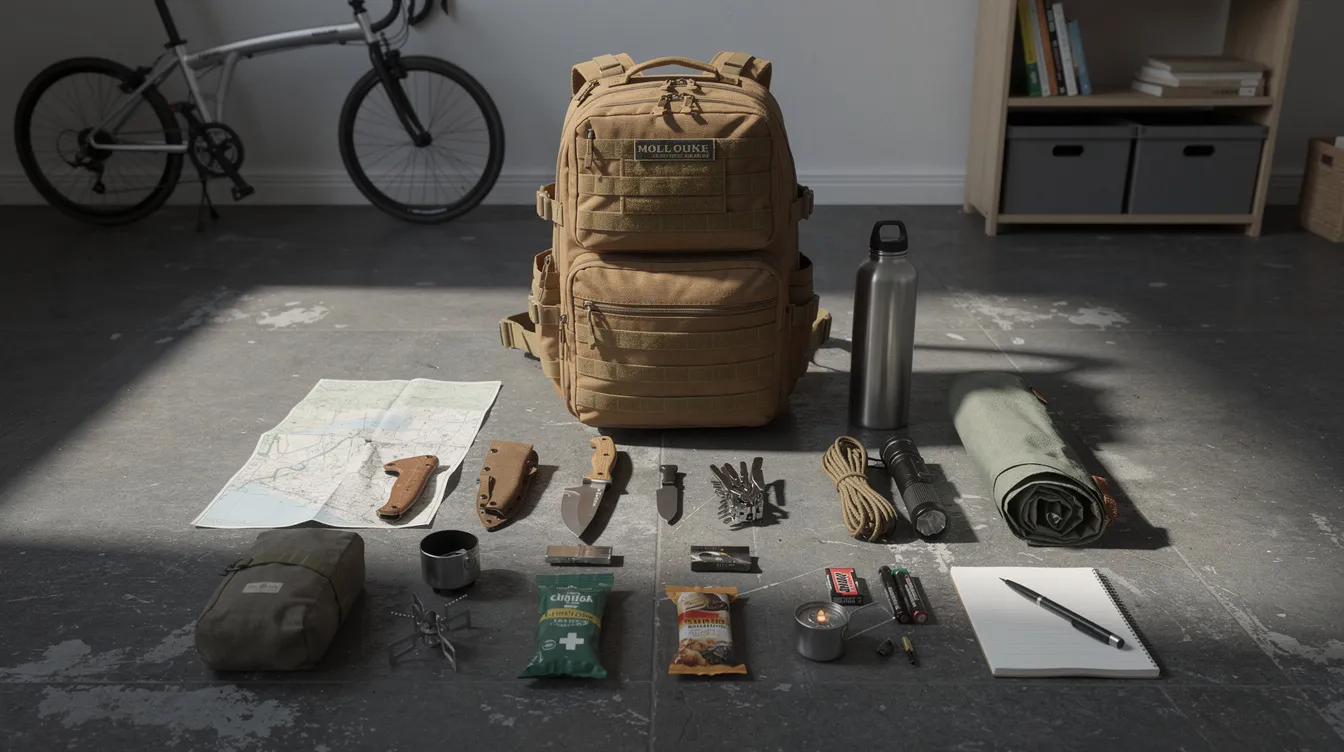
An overhead, photorealistic view of a 25–35L coyote-brown MOLLE backpack opened flat on a dark wood loft floor. Every item is grid-laid with military precision: vacuum-sealed rations, a metal canteen, an IFAK pouch, a multitool, a folded poncho, a compact radio, chem lights, paracord, and an emergency blanket. In the background, a folding bike leans against a narrow bookshelf - a reminder that this is a real apartment, not a barracks. Emergency kits often include food, water, and first aid supplies, but here you can see how a military approach organizes those same categories into something far more deliberate.
2. Detail Shot of Organized MOLLE Pouches
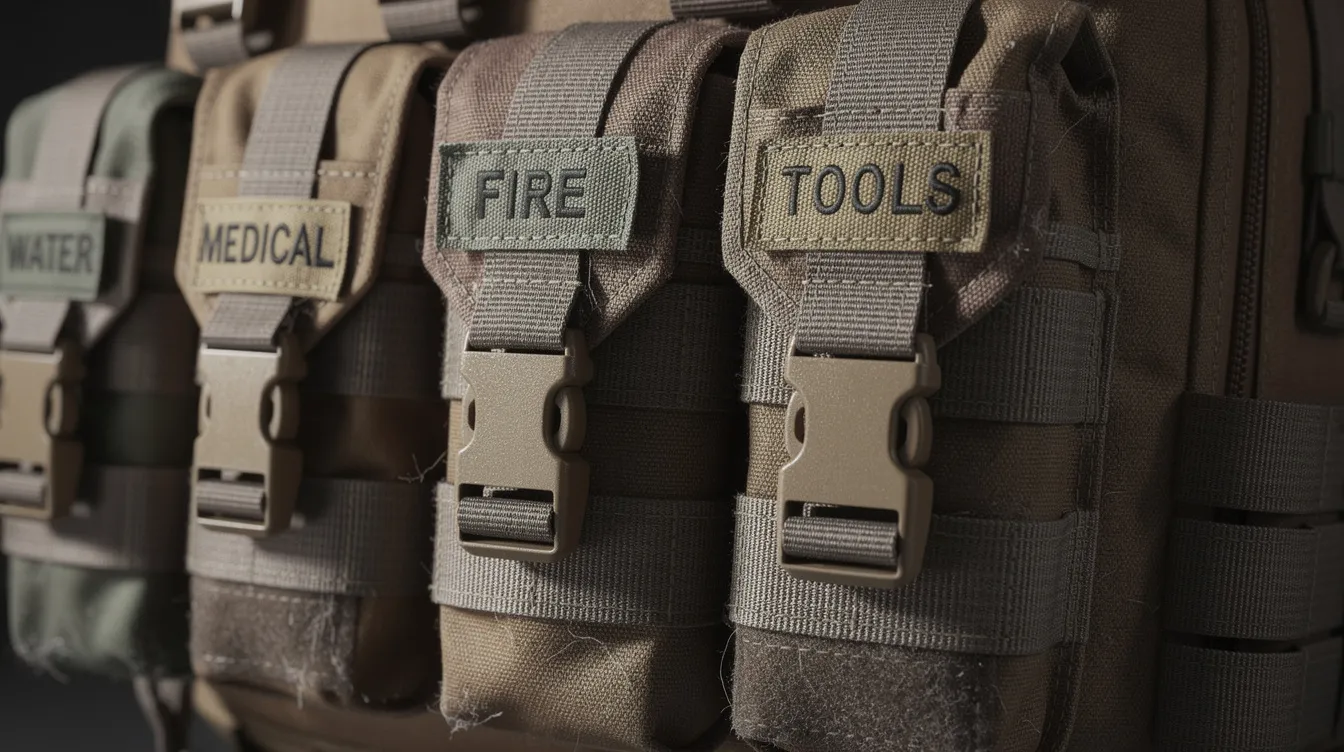
A close-up, side-lit capture of the pack's exterior MOLLE webbing with pouches clearly labeled: "MED," "FIRE," "WATER," and "TOOLS." The shallow depth of field pulls your eye to the heavy stitching, the 1000-denier Cordura texture, and the metal buckles that won't snap under stress. This is what modularity looks like - the ability to grab a single pouch and go, or detach a medical module to help a neighbor, without unpacking your entire bag.
3. Mini Military Survival Tin on a Studio Apartment Desk
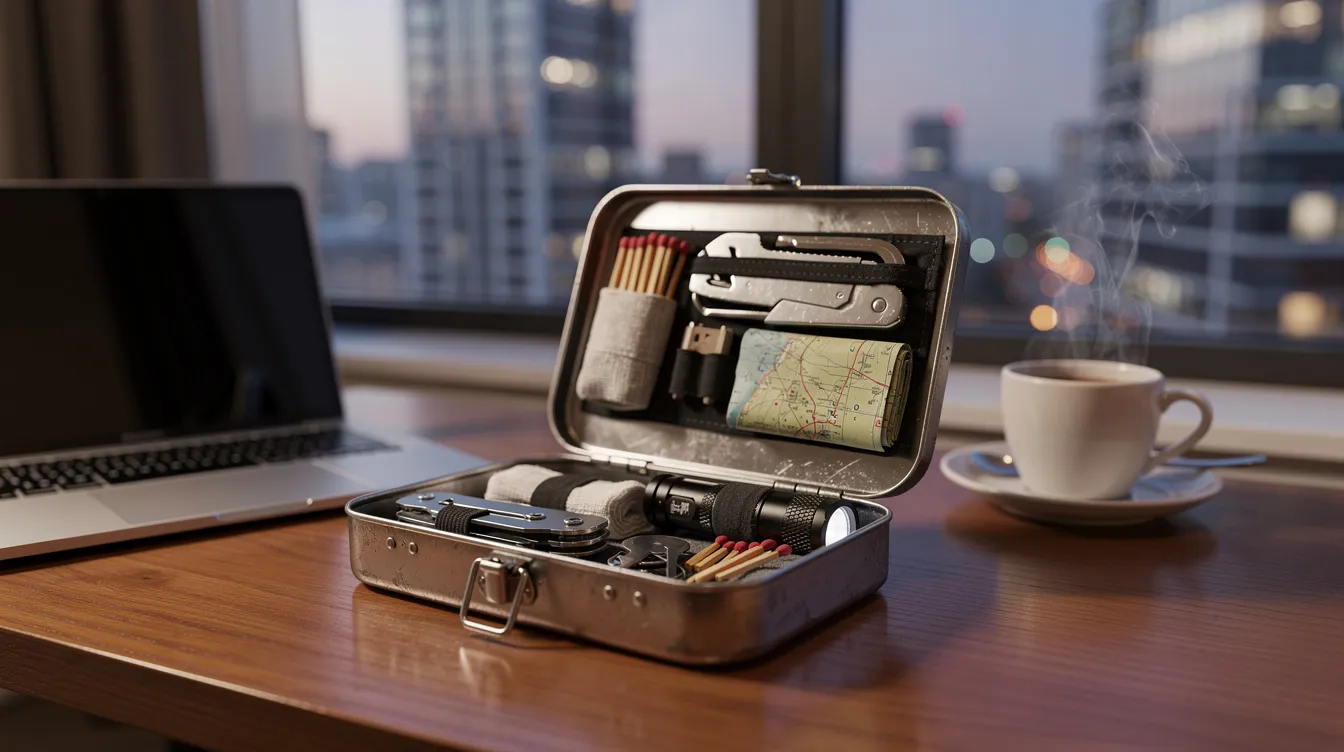
Not every kit needs to fill a backpack. This photorealistic shot shows an Altoids-sized metal survival tin open on a studio desk beside a laptop and coffee cup. Inside: a micro compass, ferro rod, water purification tablets, folded duct tape, a micro fishing kit, and safety pins. An urban skyline fills the small window behind. A multi-tool enhances versatility in emergencies, and this tiny collection proves that even the smallest items can cover essential survival needs. Planning a survival kit involves ensuring it covers key survival needs in emergencies - this tin handles fire, water, navigation, and repair in a footprint smaller than a paperback.
4. 72-Hour Military Bug-Out Bag by the Front Door
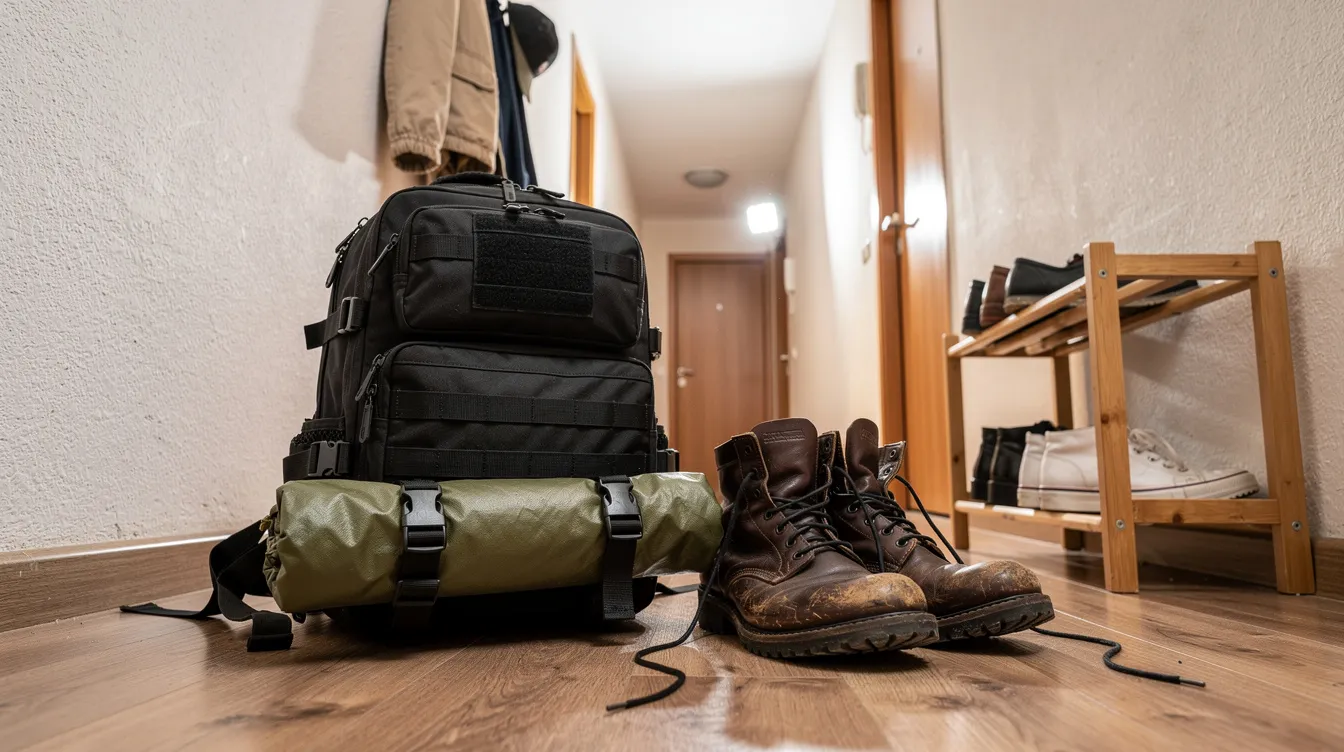
A wide HDR shot of a tiny apartment hallway: a single tactical backpack staged by the front door with boots tucked underneath. A rolled patrol tarp is lashed to the bottom, a compact sleeping bag strapped below, carabiners and gloves clipped to the sides. Coat hooks, a shoe rack, and barely two feet of floor space frame the image - proof that a full 72-hour bag fits into even the most cramped entryway. Bug-out bags are essential for natural disaster preparedness, and staging one by the door means you never have to wait or search when evacuation orders come.
5. Medical Module (IFAK) Open on Kitchen Counter
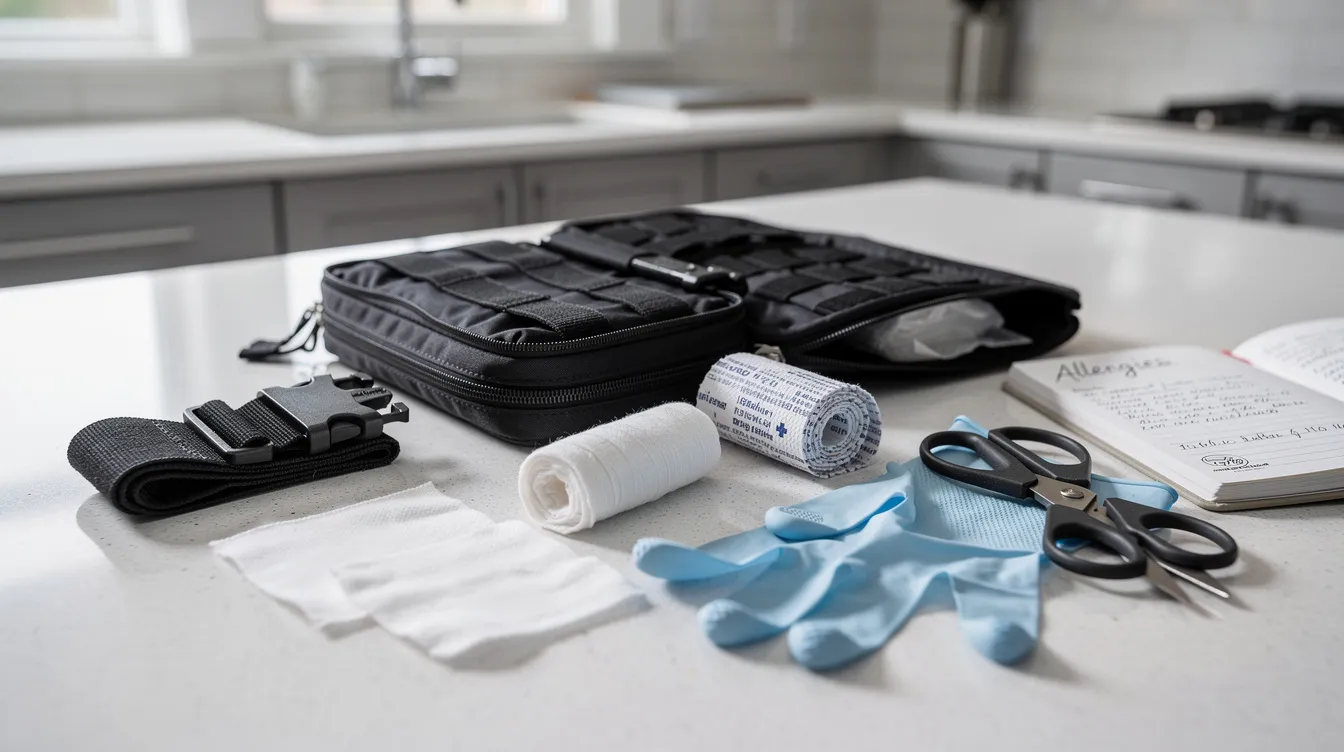
Counter-level perspective in a small galley kitchen: an opened red-cross-marked IFAK pouch with its contents in clear view. A tourniquet dated 2026, an Israeli bandage, nitrile gloves, trauma shears, sterile gauze, antiseptic wipes, and a small notebook labeled "Allergies / Meds." Emergency medical supplies should include sterile gauze, antiseptic wipes, and tourniquets - not just the adhesive bandages you'd find in a basic first aid kit. An emergency first aid kit is essential for survival, and this image shows what a genuinely capable one looks like. Clean, bright lighting contrasts with the rugged tactical shots elsewhere, emphasizing precision.
6. Water and Rations Packed in a 20L Tactical Daypack
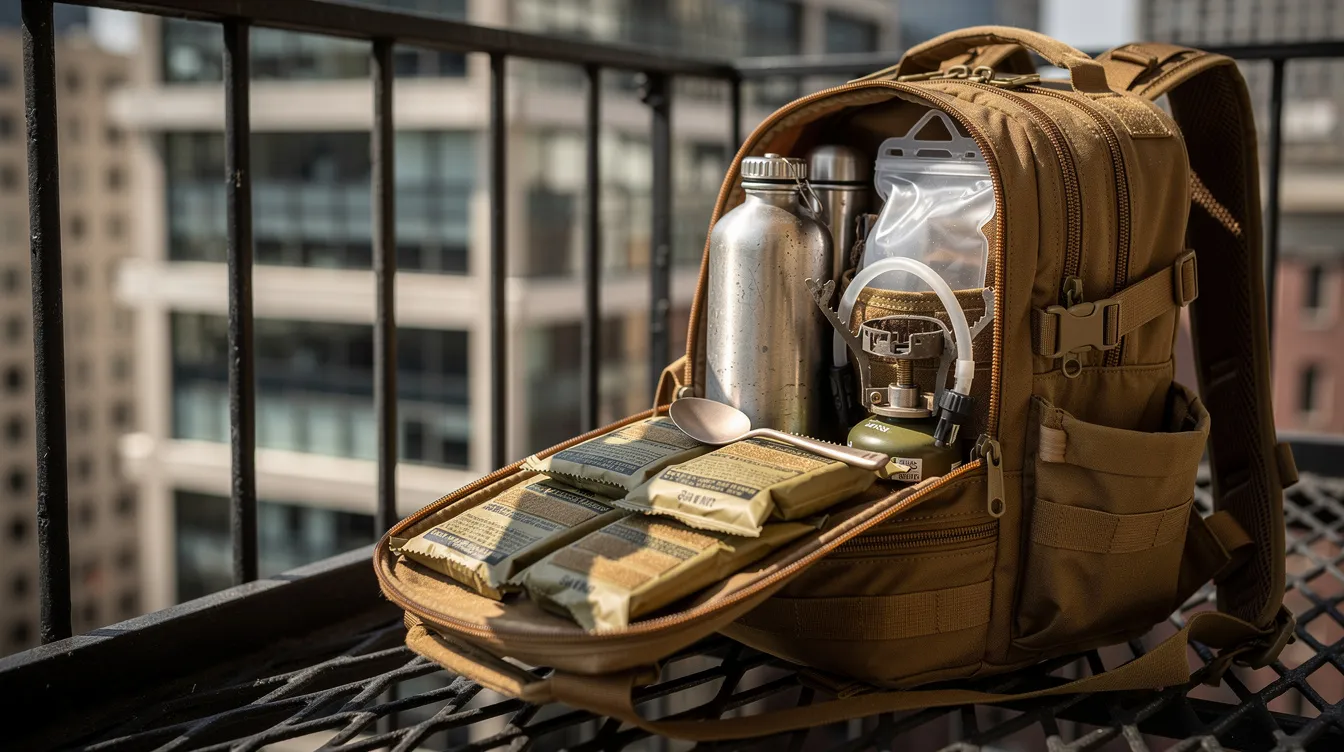
Side view of an open 20L daypack on a small fire escape balcony. A 500ml metal canteen, collapsible water bladder, U.S. military-style MRE packets, a compact titanium spork, and a tiny solid-fuel stove nest together with zero wasted space. City buildings blur softly in golden-hour HDR lighting. Water purification tablets kill harmful bacteria, viruses, and parasites in untreated water sources, and a small bottle of them sits tucked alongside the canteen - barely noticeable but potentially lifesaving.
7. Nighttime Power-Outage Scene with Tactical Lighting
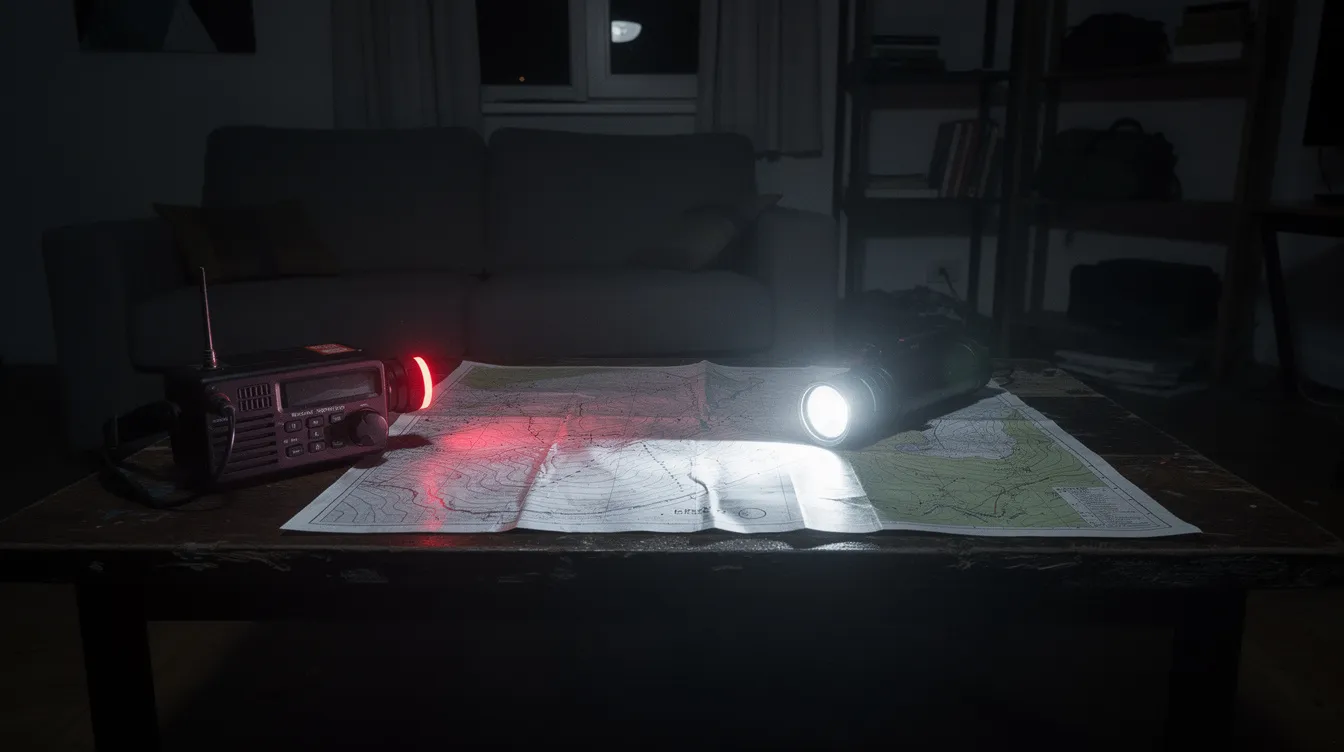
A low-light interior shot of a small apartment during a simulated blackout. The only illumination comes from a tactical flashlight and a low-lumen red headlamp, casting dramatic beams across a map and handheld radio on a coffee table. This noise-free HDR capture shows beam quality and creates an immediate emotional connection to real emergencies - the kind of scenario where survival gear prepares you for unforeseen emergencies that arrive without warning. Signaling devices help alert search-and-rescue teams visually or acoustically, and the radio and flashlight here serve double duty for both communication and signaling.
8. Military Survival Kit Stored Under a Bed
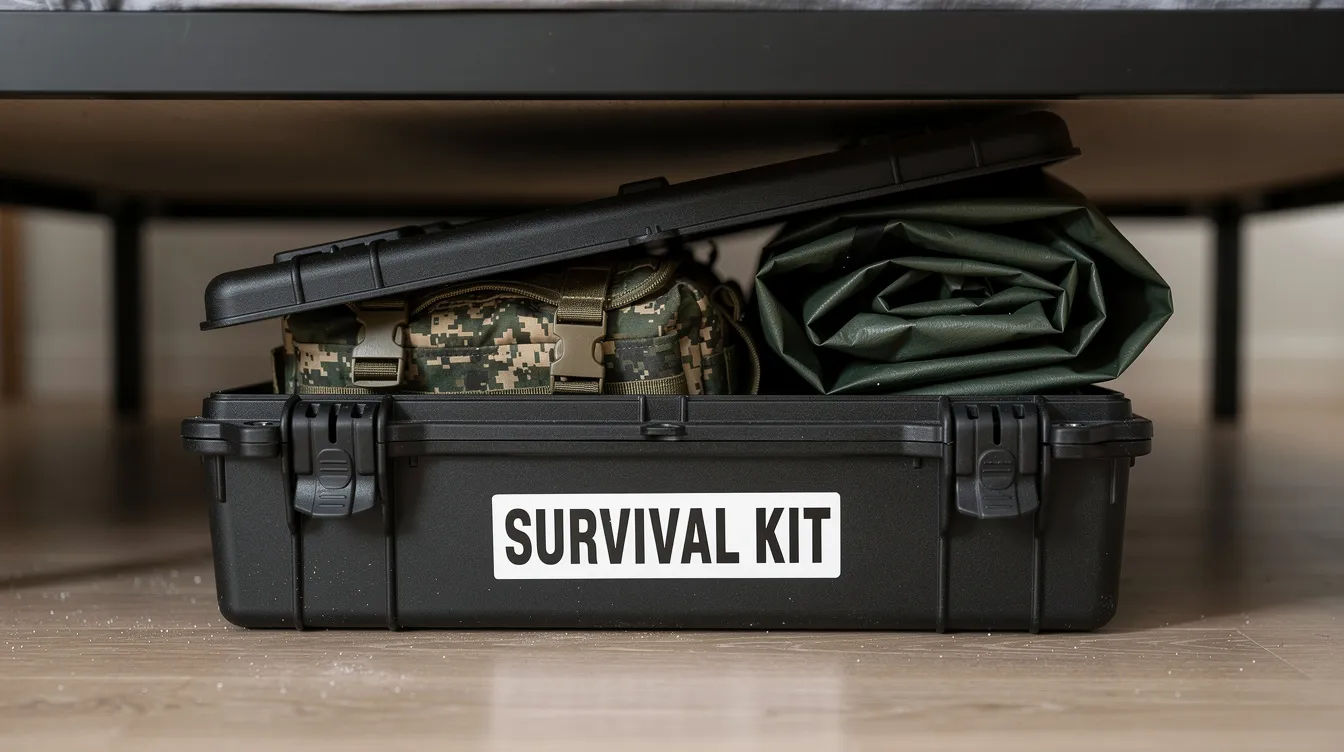
Ground-level HDR shot peering under a platform bed in a studio apartment. A flat tactical storage bin labeled "SURVIVAL KIT" sits with barely three inches of clearance, camo gear and a folded compact tarp partially visible through its open lid. This is the storage strategy that makes military-level preparedness possible in a home with no garage, no basement, and no spare closet. The bin slides out in seconds - easy to grab, easy to forget is even there until you need it.
9. Side-by-Side Comparison: Civilian vs. Military-Style Kit
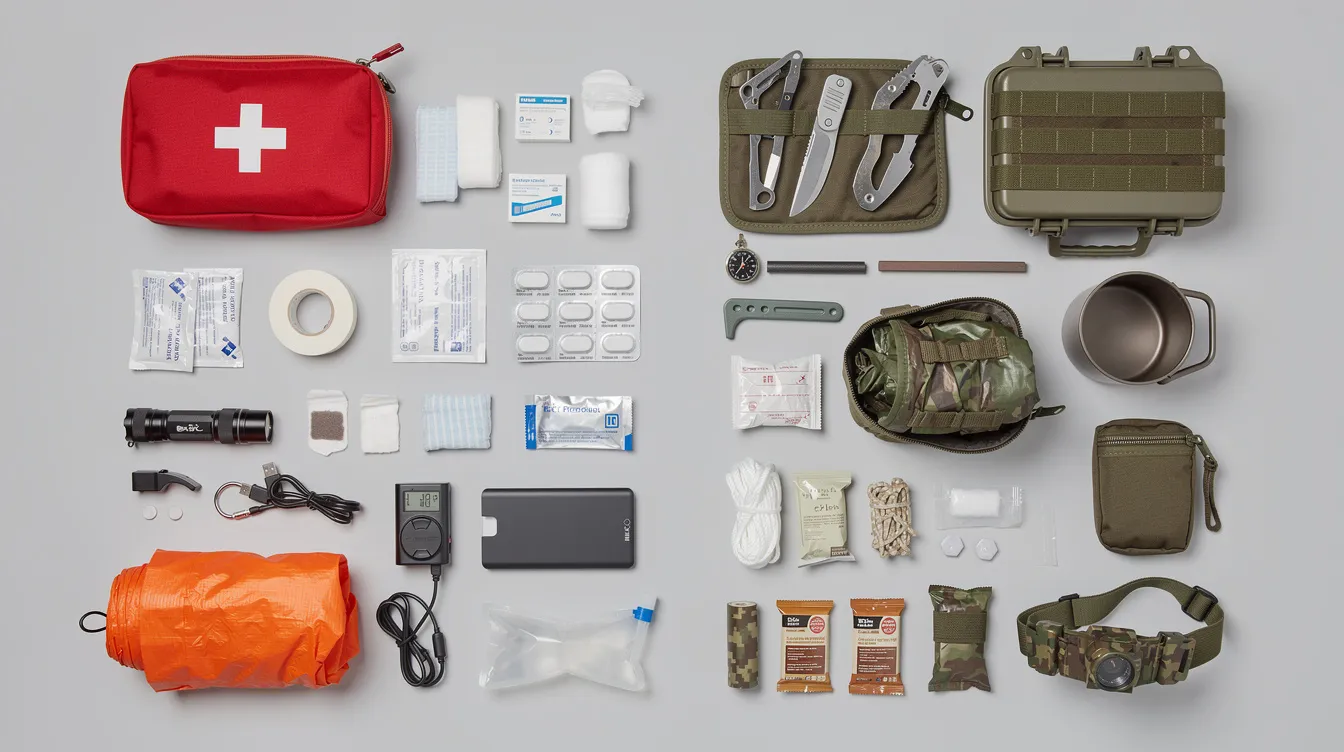
An overhead comparison on a neutral background: on the left, a typical bright-red plastic civilian emergency kit; on the right, a compact olive-drab military survival kit. Items are arranged in parallel rows - both include water, food, light, and first aid, but the military kit shows a Cordura build, real tools, a fire steel, a tourniquet, and a signaling mirror where the civilian kit has plastic packaging and basic supplies. Even lighting keeps this clinical and honest. An emergency survival kit should be tailored to its intended environment, and this image makes clear which approach takes that principle seriously.
10. Packed Get-Home Bag Under an Office Desk
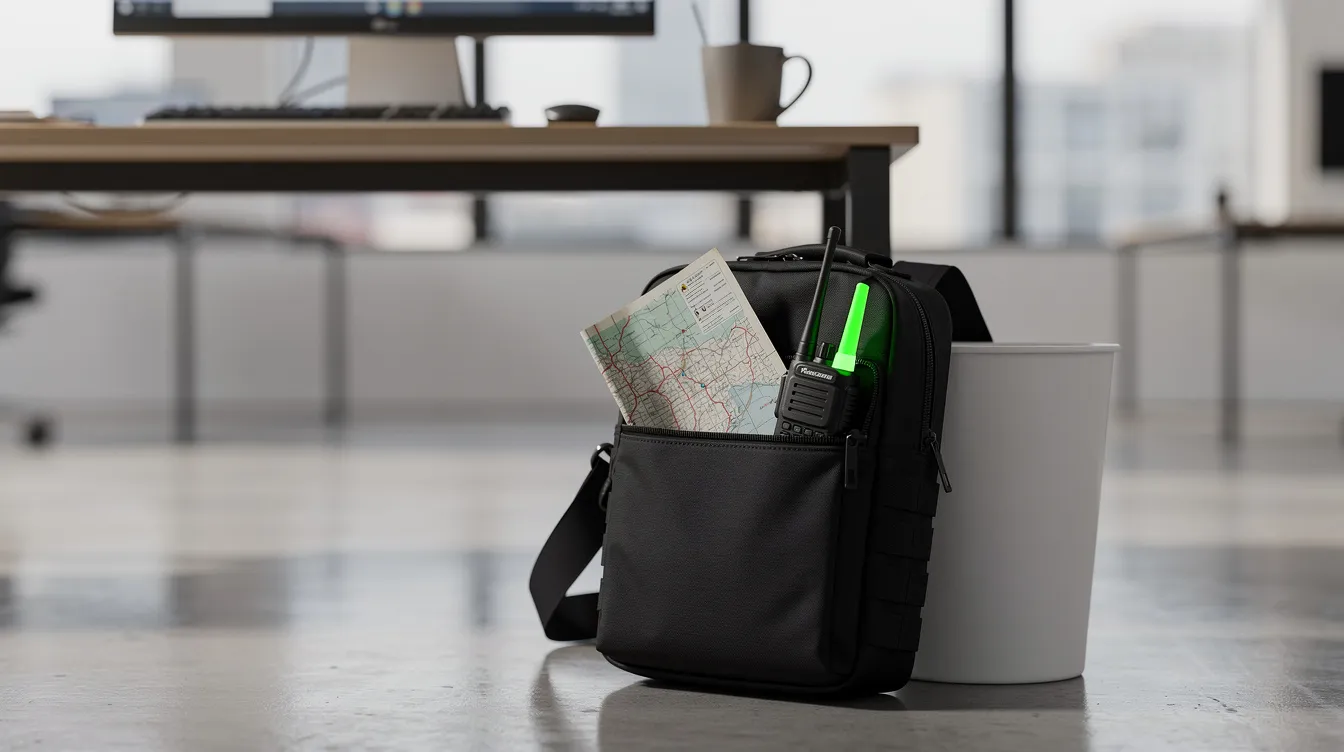
Photorealistic coworking scene: a small standing desk, and tucked beside the trash can, a slim tactical sling bag. One pocket is slightly open, hinting at contents - a folded map, compact radio antenna, glow stick, notebook, pen, and compact emergency blanket. Navigation tools like compasses and maps are critical in unfamiliar terrain during emergencies, and this discreet bag carries them without drawing a single glance from coworkers. You can keep military-grade readiness in a tiny workspace without anyone knowing.
11. Family of Two with Matching Military Kits in a Hallway
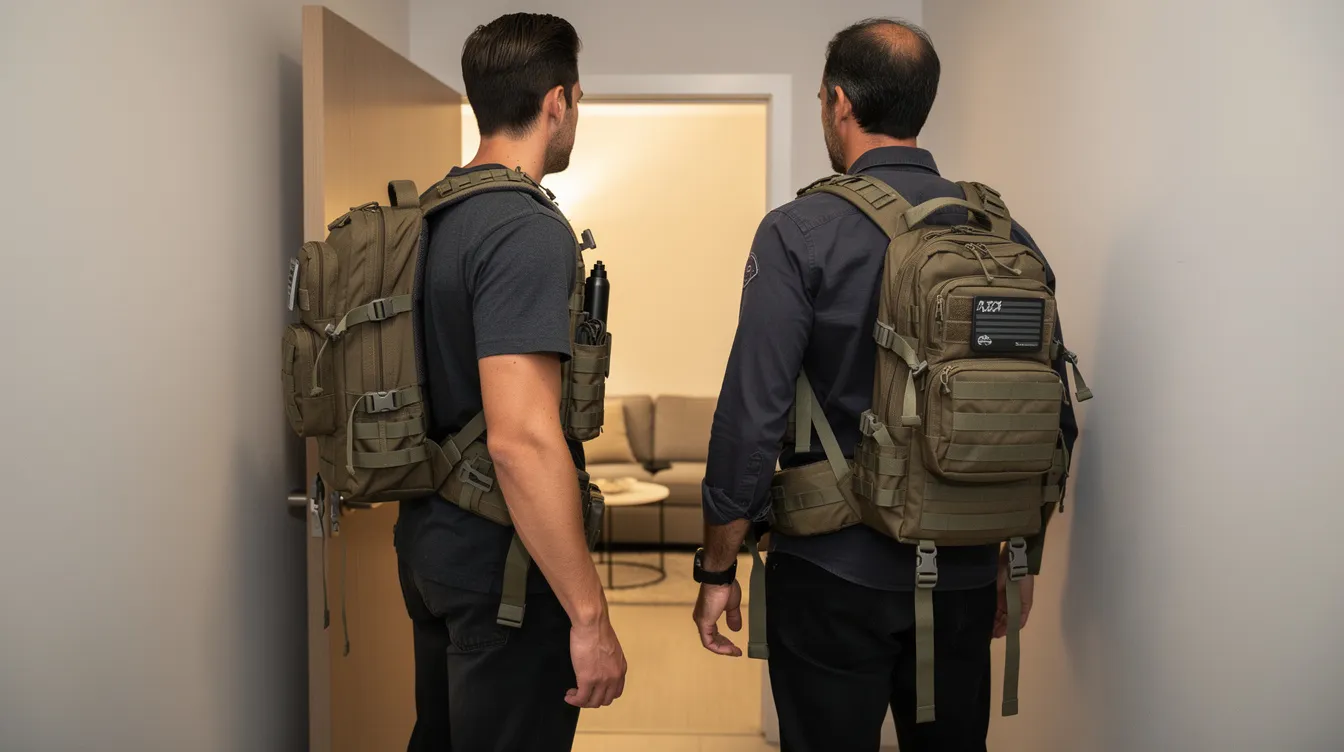
A couple stands in the narrow hallway of a small condo, each wearing a fitted tactical backpack sized for their frame. The apartment door is open behind them, showing just how small the living space is - and how the packs still don't overwhelm their builds. HDR natural light from the doorway, soft focus on faces, sharper focus on pack straps and chest rigs. This is what a coordinated family system looks like when both partners are ready to leave in under sixty seconds.
Types of Military Survival Kits
Military survival kits come in several distinct formats, and choosing the right type depends on your available space, daily lifestyle, and the primary threats you face. Not everyone needs a full rucksack; some people need a pocket-sized kit for their commute and a set of modules stacked under the bed. Below are the main types worth exploring across our collection.
Individual 72-Hour Military Bug-Out Bags
The classic three-day pack - modeled on U.S. Army FM 3-05.70 survival doctrine - is the backbone of personal emergency readiness. 1 Person Emergency Kits typically last for 72 hours and contain water containers plus purification (filters or tabs), food providing 2,000–2,500 calories per day, shelter (poncho plus bivy or thermal blanket), an IFAK with trauma-grade medical supplies, at least two fire-starting methods, navigation tools, lighting, and gloves.
This type is ideal for solo apartment dwellers, students in dorms, and renters who may need to escape on foot or via public transit. Essential tools for a survival kit include a knife, fire starter, and water purification gear - all of which fit into a 20–30L bag weighing under 25 pounds. That weight target matters: it keeps the pack manageable on narrow stairwells and crowded subway platforms. Include a fire starter in your survival kit - fire provides heat, purifies water, cooks food, signals for rescue, and offers psychological comfort.
Family or 2–4 Person Military Survival Kits
For a family or couple sharing a small apartment, the approach shifts from one big bag to a coordinated system: one main pack (35–45L) plus smaller "mission" bags for each person. Military doctrine spreads weight intelligently - one person carries the medical module, another the shelter and cooking gear, another the water and food. This way no single household member is overburdened during walking evacuation.
In a 600-square-foot city apartment, a 2-person kit might include shared items (compact stove, tarp, cooking pot) stored in one duffel under the bed, with each partner maintaining a personal 15L daypack holding their own water, rations, clothing layer, and prescriptions. The whole system nests inside a single closet or slides under a platform bed frame.
Vehicle-Based Military Survival Kits
Vehicle kits are designed to live in a trunk or under an SUV seat, where heavier gear is permissible because you're not walking with it - until you are. These typically include a shovel, traction aids, extra blankets, large water jugs (5–10 liters), a vehicle repair kit, and robust signaling equipment. Survival gear helps manage sudden weather changes, and a car kit should account for being stranded in extremes.
For small-space readers who rely on shared parking garages or street parking, security matters: keep gear in a locked trunk or bolted storage box, and choose temperature-tolerant items (avoid storing water in plastic that warps in summer heat). If you ever need to abandon the car, a smaller grab bag should be ready to transfer to your back in seconds.
Micro EDC (Everyday Carry) Military Kits
An EDC kit is the pocket-sized or belt-mounted layer you carry every day: a multitool, small flashlight, a single tourniquet or pressure bandage, a micro fire starter, and perhaps a compact communication device. Tactical kits are pre-packed for various emergency scenarios, and an EDC bridges the gap between your daily routine and your full bug-out bag at home.
The layering concept works like this: on-person EDC handles the first minutes of an emergency, the grab-and-go pack at your door covers 72 hours, and the home-base modules support shelter-in-place for a week or more. For office workers, train commuters, and cyclists in crowded cities, the EDC is the layer that's always with you - no matter how far you are from home when something goes wrong.
Home Base Military Survival Modules
Home-base modules are the supplies you keep stored in a closet, under furniture, or in stackable bins for shelter-in-place scenarios: extended water reserves, long-shelf-life food, a battery bank or small solar panel, a communication radio, and expanded medical supplies. Emergency kits should include food, water, and warmth - and home modules provide these in greater quantities than any bag you could carry.
These differ from bug-out bags because they prioritize sustainment over portability - five to seven days or more of self-sufficiency without leaving your apartment. For tiny homes and micro-studios, the strategy is compressible, clearly labeled bins that double as furniture or slide into dead space behind doors and under bed frames.
What to Look For in a Military Survival Kit
The difference between a kit you can trust with your life and one that falls apart under stress comes down to specific, measurable features. Here's what separates reliable, combat-inspired products from the throwaway options flooding the market.
Rugged, Field-Tested Gear (Not Gimmicks)
Real durability starts with materials: ripstop nylon or Cordura in the 500–1000 denier range for bags, YKK zippers, metal (not plastic) buckles, and waterproof coatings. Flashlights should carry an IPX7 rating (submersion-resistant), and any items marketed as "military specification" should have verifiable testing standards - not just a label.
Avoid the novelty "14-in-1 credit card tools" and similar gimmicks that selling points suggest versatility but crumble under actual use. Look for:
- Metal-body flashlights with ANSI FL1 ratings
- Ferro rods with magnesium strikers (not plastic handles)
- Waterproof match containers with strike-anywhere capability
- Knives with full-tang construction
Modular Organization and Fast Access
The military concept of "first line / second line / third line" gear translates directly to small-space kits. First line is on your body (EDC). Second line is your grab bag. Third line is your home reserves. Within each, color-coded or clearly labeled pouches - red for medical, blue for water, orange for signaling - let you find what you need in darkness or panic.
In a studio or one-bedroom, organized modules mean you can detach just a med pouch to help a neighbor, or grab only the water module for a short disruption, without tearing apart your entire setup. Fast access saves time, and time is the one resource you can't buy more of during an emergency.
Core Survival Priorities Covered (Rule of Threes)
The Rule of Threes states survival priorities are air, shelter, water, and food - minutes without breathable air, hours without shelter in extreme weather, days without water, weeks without food. A good military kit covers each layer:
- Air/Respiratory: N95 masks or better; the 2025 LA wildfires proved that respirators and eye protection are not optional in smoke events
- Shelter: Poncho, bivy, or thermal blanket; emergency blankets reflect body heat and protect against environmental exposure
- Water: Containers (at least 3L capacity) plus purification tabs or a compact filter; adults need 2–3 liters per day in temperate conditions, rising to 4–6 liters in hot climates or under exertion
- Food: Dense, no-cook rations providing 2,000–2,500 kcal per day; MREs or equivalent calorie-dense bars
- Signaling: Mirror, chem lights, whistle; emergency kits should include communication devices like whistles, signal mirrors, and radios
Medical Capability Beyond Band-Aids
Military-inspired kits include trauma care that goes far beyond a basic first aid kit: a tourniquet (CAT or SOF-TT style), an Israeli pressure bandage, hemostatic gauze, and trauma shears. First aid kits are crucial for outdoor enthusiasts, but they're equally critical for urban dwellers who may face injuries from structural collapse, broken glass, or falls during evacuation.
Pair this gear with training - a Stop the Bleed course takes under two hours and can mean the difference between providing effective aid and watching helplessly. A field manual provides valuable survival tips, and a laminated quick-reference card tucked into your IFAK adds a critical backup when stress degrades memory. Space-saving tricks include flat-packed gauze, vacuum-sealed gloves, and soft pouches that mold to the pack shape.
Small-Space Suitability and Weight
Weight and volume caps are non-negotiable for small-space dwellers. Military load doctrine puts a soldier's fighting load at roughly 30% of body weight - but civilian kits should aim for 10–15%, rarely exceeding 20%. For an average adult weighing 150–170 pounds, that means keeping the main bag under 20–25 pounds.
Volume guidelines: 20–30L for a single urban dweller, 35–45L shared kit plus smaller daypacks for couples. Prioritize compressible and multi-use items - a poncho that doubles as shelter and rain gear, a stove that nests inside its cooking pot, paracord that replaces six single-purpose accessories. Every cubic inch matters when your entire home is 350 square feet.
Documentation, Checklists, and Training Aids
Even experienced users forget steps under stress. Include laminated quick-reference cards: how to apply the tourniquet, fire-starting steps, local radio frequencies, emergency numbers, and your personal evacuation plan with meet-up points and pet instructions.
A printed, small-format emergency plan specific to your city isn't just nice to have - it's a core component of a true military-inspired kit. During the Camp Fire in Butte County, California, 31 temporary refuge areas saved at least 261 lives, but many residents had no preplanned evacuation routes and lost precious minutes deciding where to go. Documentation eliminates that decision paralysis.
How to Choose the Right Military Survival Kit for Your Space
Turning features into a decision means honestly assessing your situation across five criteria. Here's how each one changes the right pick.
- Your Living Situation - Housing type drives kit architecture. In a high-rise apartment where elevators may fail, prioritize weight and stair-carry comfort plus smoke and air protection. A 2026 analysis of NYC small buildings and climate vulnerability found that basement and subgrade units face severe flooding risk while upper-floor residents face heat and stair-access challenges - the same building can demand two different kit strategies. In a basement or garden unit in flood-prone areas, prioritize waterproof storage and elevated placement. In a micro-studio, lean toward modular bins and slim packs that slide under furniture.
- Primary Local Threats - Your risk profile should drive your gear selection. In wildfire belts like Northern California or Colorado's Front Range, add respirators, eye protection, and vehicle-based kits with maps pre-marked with multiple escape routes. In hurricane zones along the Gulf Coast, build for more water storage, tarps, cordage, and the ability to shelter in place for several days. In blizzard and ice-storm regions, add extra insulation layers, chemical hand warmers, and traction aids. Survival gear is essential for camping and hiking trips, but it's equally essential for simply surviving in your own neighborhood when conditions turn hostile.
- How You Move Day-to-Day - Public-transit commuters need lighter, more compact packs with emphasis on a get-home bag plus home-base modules. Car owners benefit from a robust trunk kit plus a smaller pack that can be quickly transferred if the vehicle must be abandoned. Cyclists need slimline backpacks or sling bags with stable load distribution that won't shift while riding.
- Budget and Build Strategy - A micro EDC runs $50–$100 to build. A solid 72-hour kit for one person costs $200–$400 if assembled gradually. Family systems run $500 or more over time. Start with a strong medical and water module - these are the items where the price of going cheap is highest - then layer in food, shelter, and tools month by month. For those who prefer to purchase a ready-made option, a hybrid approach works well: buy a solid base kit, then customize with personal meds, clothing, documents, and local-risk items. Assembling your kit incrementally makes the cost manageable and ensures every item earns its place.
- Physical Ability and Comfort Level - Test your pack weight on stairs before you finalize the build. Adjust so the smallest or least-fit household member can carry their share without exhaustion. If you're new to survival skills, choose low-skill-floor gear: stormproof matches plus a ferro rod (redundancy without complexity), ready-to-eat rations versus complex camp cooking, and a water filter with simple squeeze operation. The goal is providing confidence, not adding stress.
Frequently Asked Questions About Military Survival Kits
These questions cover the queries we hear most from urban and small-space preppers looking to build or improve their military-style kits.
What should be in a basic military-style survival kit for one person?
A basic kit for one adult covers 72 hours and should contain: at least 9 liters of water (three 1-liter containers plus purification tablets or a compact filter), food providing roughly 2,000–2,500 kcal per day (approximately 7,000 kcal total - three MREs or equivalent dense rations), a poncho and compact bivy or emergency blanket for shelter, an IFAK with tourniquet, Israeli bandage, hemostatic gauze, antiseptic wipes, and nitrile gloves, two fire-starting methods (lighter plus ferro rod), a headlamp and small backup flashlight with extra batteries, a signaling mirror and whistle, a map and compass, an N95 or better respiratory mask, work gloves, a multitool or fixed-blade knife, and a laminated quick-reference card. Target weight: 20–25 pounds. Target volume: roughly 25 liters.
How heavy should my military survival kit be if I live in a walk-up apartment?
Aim for 10–15% of your body weight - for a 150-pound adult, that's roughly 15–22 pounds. If your building is above four floors without a working elevator, stay at the lower end of that range. The best way to find your limit is a test walk: load the pack and walk up and down your full staircase twice. If you're gasping or your knees are protesting, remove items or redistribute weight to a partner's kit. Every pound you cut increases your chances of actually making it out.
Can I keep a military survival kit in a small apartment without it looking "tactical"?
Absolutely. The military function lives inside the bag, not on the outside. Choose muted civilian colors - charcoal gray, dark navy, or even a regular hiking-style pack - and store modules in flat bins under your bed or in closet boxes. All the rugged, field-tested gear fits just as well inside a bag that looks like outdoor enthusiast equipment as it does inside an olive-drab MOLLE pack. For readers who prefer a low visual profile, especially in dense urban buildings, discreet colors avoid unwanted attention while keeping you fully prepared.
Is it better to buy a pre-made military survival kit or build my own?
Both approaches have merit. Pre-made kits save time and offer a curated collection of items that someone has already tested for compatibility and size - great for people who want to be ready fast. The trade-off is that some pre-mades on sale at big retailers include filler items you don't need and skimp on the items that matter most (medical and water). Building your own lets you tailor every component to your specific environment and needs, but demands more research and shopping time. The best way: purchase a solid base kit for the bag, shelter, and fire components, then add your own medical module, personal prescriptions, climate-specific clothing, and local documentation.
How often should I update or rotate items in my military survival kit?
Set a recurring date - the first weekend of each daylight-saving time change works well - for a full review. Specific rotation schedules: water containers should be rotated annually (or sooner if stored in heat), MREs and food rations replaced per their printed expiry dates (often 5+ years for MREs but check each batch), medical supplies inspected every 6–12 months for sterility and adhesive integrity, batteries tested monthly or replaced on a fixed annual cycle, and clothing layers swapped seasonally. A kit you never inspect offers a false sense of security - leave the guesswork out by building rotation into your calendar.
Are military-grade items always better than civilian gear?
No - and the term "military-grade" is often a marketing label rather than a verifiable standard. What matters is tested reliability and suitability for the user. True surplus or MIL-SPEC gear excels in certain categories: rucksacks, field dressings, ponchos, and MOLLE accessories built to government contractor specifications tend to be exceptionally durable. But civilian outdoor gear can be lighter and better in other areas - modern backpacking stoves, ultralight sleeping systems, and advanced water filters from the hiking and camping market often outperform their military equivalents in weight-to-performance ratio. The smart approach is choosing the best tool for each job rather than committing to one philosophy across the board.
Get Mission-Ready in a Small Space
A military survival kit isn't about filling every corner of your home with gear - it's about smart, layered planning that puts the right items within arm's reach when everything else fails. The approach that keeps military personnel alive under fire translates directly to keeping civilians alive during a natural disaster, and it does so without requiring a garage, a bunker, or a spare bedroom.
Even a studio apartment can support a fully capable, military-inspired setup when it's modular, compressed, and organized with purpose. An EDC in your pocket, a 72-hour bag by the door, and a set of home-base modules under the bed - three layers, one system, and every item earning its space.
Explore our range of compact kit recommendations, visual packing guides, and step-by-step checklists built specifically for small-space living. The best time to build your kit was last year. The second best time is right now.
Editorial note: this guide provides general preparedness information, not emergency, medical, legal, or engineering advice. Recommendations are cross-checked against public emergency-management guidance and adapted for small-space living. During an active emergency, follow your local authorities and emergency services. See our editorial standards and affiliate disclosure.